8/29/2023
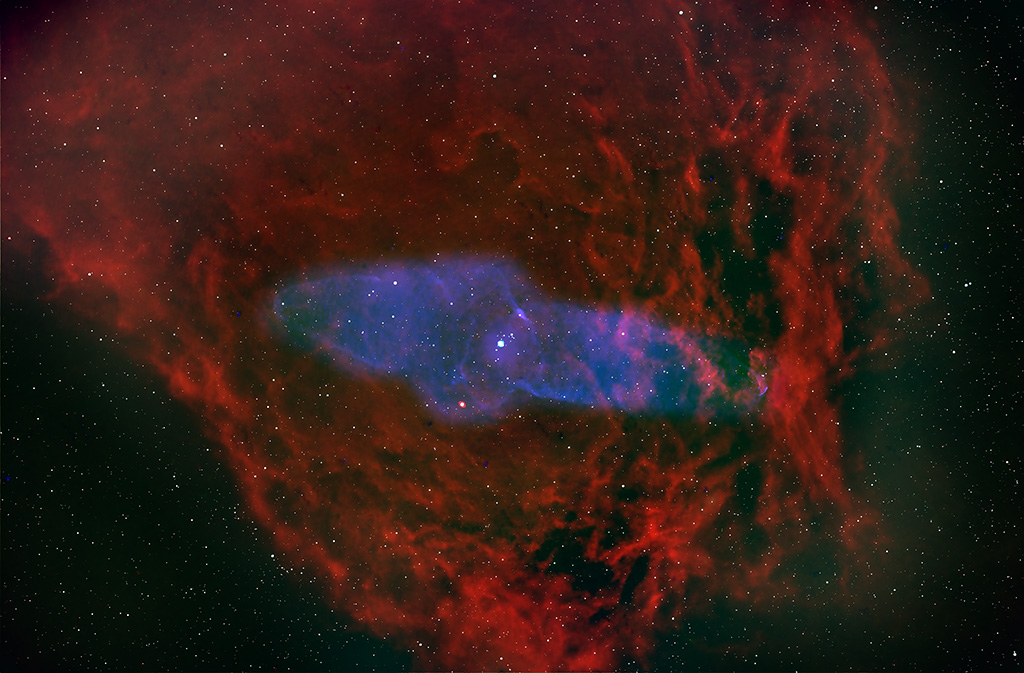
SH2-129 is a relatively faint emission nebula in Cepheus. Sometimes calledo as the “Flying Bat” nebula, this region is characterized by Hydrogen emission. Inside it we found the recent discovery made in 2011 by Nicolas Outters, called the “Squid Nebula” due to its shape, but more officially called Ou4. This region is characterized by a very faint OIII emission and its bipolar shape reminds of a planetary nebula. Wikipedia
The remarkable nebula’s bipolar shape and emission are consistent with it being a planetary nebula, the gaseous shroud of a dying sun-like star, but its actual distance and origin are unknown. A new investigation suggests Ou4 really lies within the emission region SH2-129 some 2,300 light-years away. Consistent with that scenario, the cosmic squid would represent a spectacular outflow of material driven by a triple system of hot, massive stars, cataloged as HR8119, seen near the center of the nebula. If so, this truly giant squid nebula would physically be nearly 50 light-years across. Robert Nemiroff (MTU) & Jerry Bonnell (UMCP)
Imaging Data:
Provo, Utah
Bortle 5 sky
Date August 27&28 ,2023
Image: SH 2-129
Size: 2.3 deg
Magnitude: N/A
Exposure= 240 seconds and 206 lights for a total of 13 hours and 44 minutes
Gain=100
Binning = 1×1
Camera Temperature= 0 deg C
Filter= IDAS-NBZ Narrowband Filter
Camera: ASI2600MC PRO in Hyperstar configuration.
Telescope: Celestron 1100 Edge HD
Mount : 10MICRON GM1000HPS
Processed with DSS, PI and PS