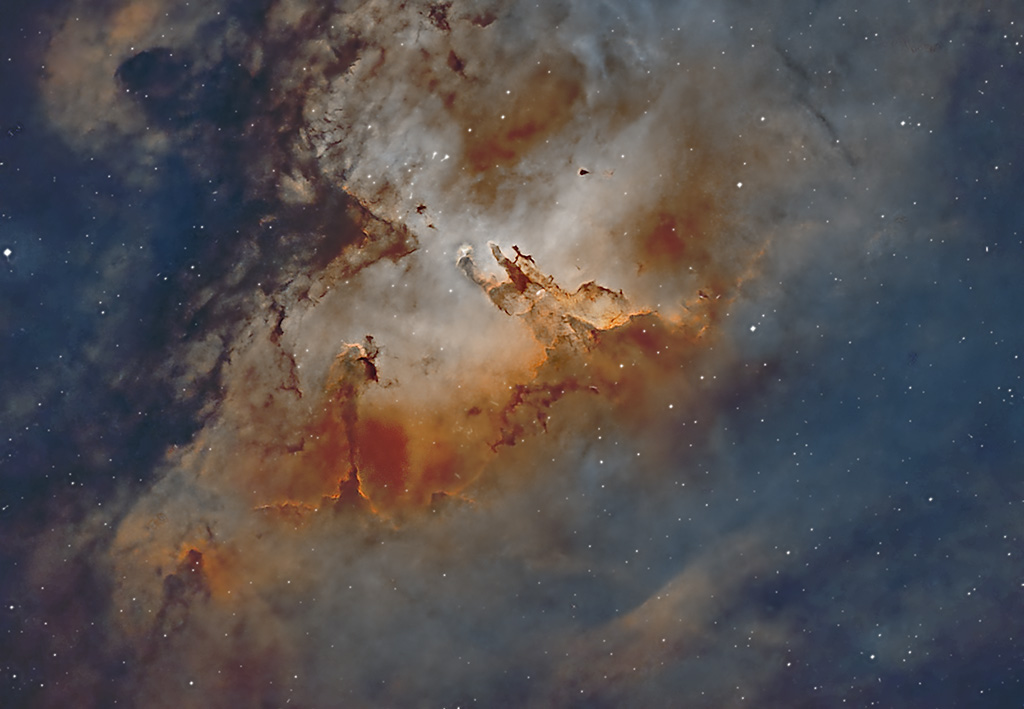
Today I reprocessed some old data I had for Messier 16.
Messier 16 (M16), the famous Eagle Nebula, is a star-forming nebula with a young open star cluster located in Serpens.
M16 lies near the borders with the constellations Sagittarius and Scutum. The nebula is best known for the Pillars of Creation region, three large pillars of gas famously photographed by Hubble in 1995.
Also known as the Star Queen Nebula, M16 lies at a distance of 7,000 light years from Earth and has an apparent magnitude of 6.0. The cluster’s designation in the New General Catalogue is NGC 6611, while the nebula is referred to as IC 4703.
The Eagle Nebula occupies an area 70 by 55 light years in size, or 30 arc minutes of the sky, while the open cluster has a radius of 15 light years, corresponding to 7 arc minutes in angular diameter.
The name Eagle comes from the nebula’s shape, which is said to resemble an eagle with outstretched wings. American astronomer Robert Burnham, Jr. introduced the name Star Queen Nebula because the nebula’s central pillar reminded him of a silhouette of the Star Queen. (MESSIER OBJECTS)
Imaging Data:
Image: M16
Date: 6/11/2020, 8/9/2020/, 7/5/2021, 8/11/2021
Exposure: 60, 180, 300 seconds
Number of Lights: 515 for 12 hours and 22 minutes of which 63 lights for 3 hours and 49 minutes were used.
Gain: 120
Binning: 1X1
Imaging Software: Sequence Generator Pro
Camera: ZWO ASI294MC Pro using Hyperstar IV.
Cooling Temp: 0 Deg C
Filter: STC Astro Duo-Narrowband
Telescope: Celestron 1100HD SCT
Mount: 10MICRON GM1000HPS
Focuser: MicroTouch Focuser