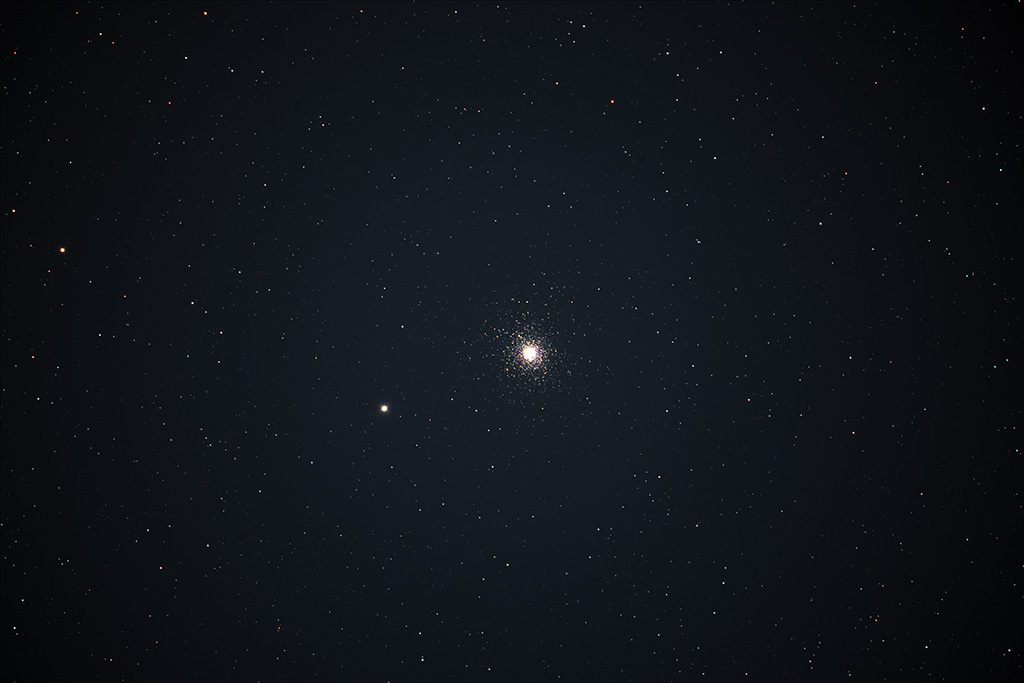
Discovered in 1702 by the German astronomer Gottfried Kirch, M5 is one of the oldest globular clusters in the Milky Way galaxy. With an apparent magnitude of 6.7 and a location 25,000 light-years away in the constellation Serpens, M5 appears as a patch of light with a pair of binoculars and is best viewed during July.
A majority of M5’s stars formed more than 12 billion years ago, but there are some unexpected newcomers on the scene, adding some vitality to this aging population.
Stars in globular clusters are believed to form in the same stellar nursery and grow old together. The most massive stars age quickly, exhausting their fuel supply in less than a million years, and end their lives in spectacular supernova explosions. This process should have left the ancient cluster M5 with only old, low-mass stars.
Yet astronomers have spotted many young, blue stars amongst the ancient stars in this cluster. Astronomers think that these laggard youngsters, called blue stragglers, were created either by collisions between stars or other stellar interactions. Such events are easy to imagine in densely populated globular clusters, in which up to a few million stars are tightly packed together.
NASA
IMAGING DATA
Date 6/15&16/2023
Exposure 240 sec
No. of lights 110 of which 40 were used for 2 hours 40 minutes
Gain 100
Binning 1×1
Temp 0 deg C
Camera ZWO AMI2600MC Pro using Hyperstar IV
Filter IDAS-NBZ Nebula Boost Filter