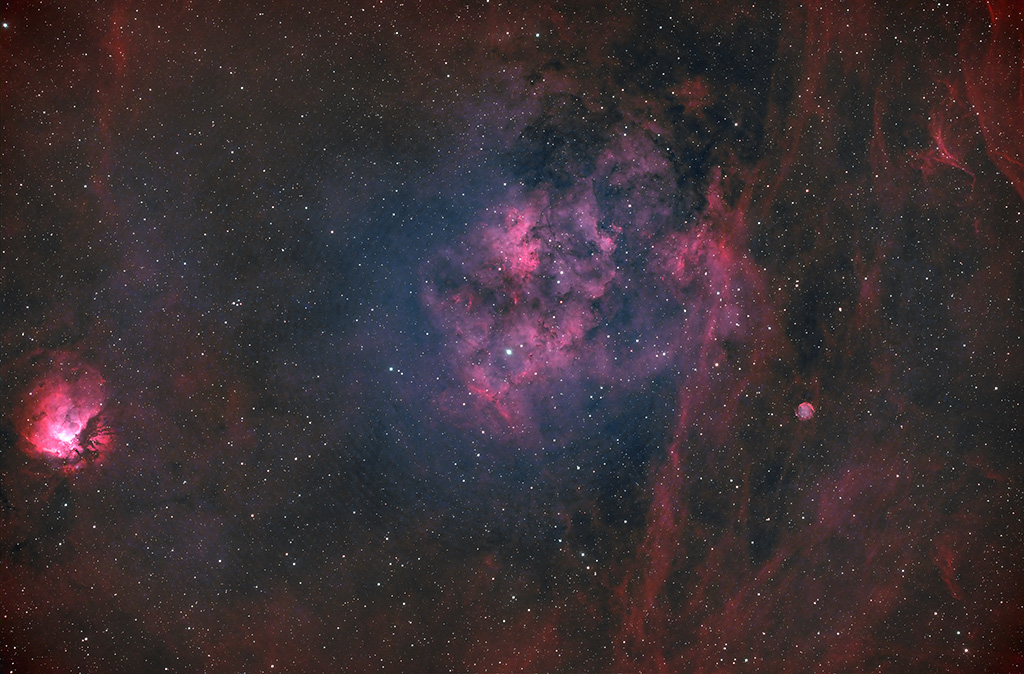
10/2/2023. SH 2-115
Sh2-115 is an emission nebula visible in the constellation Cygnus.
It is located in the northern part of the constellation, about 2.5° northwest of the bright star Deneb; the most suitable period for its observation in the evening sky falls between the months of July and December and is considerably easier for observers located in the regions of the Earth’s northern hemisphere.
It is a H II region of considerable extension with an oval shape and crossed in a northwest-southeast direction by a dark band that apparently divides it into two equal parts: the eastern part is dominated by the presence of a small open cluster, known as Berkeley 90 , with which it is physically associated, while the western part lies in the direction of the variable star α2 CVn HD 196178 (V2015 Cyg), with an average apparent magnitude of 5.63; however, the distance of this star from the Sun is equal to just 148 parsecs (481 light years), significantly lower than that estimated for the nebula, approximately 2300 parsecs (7500 light years). The stars responsible for the ionization of the gas are LS III +46 12, of spectral class O6III, DM46 2972, of class O9.5V, and DM46 2978, of class B0III; the first of these dominates the Berkeley 90 cluster.[2] The star BD+46 2972 also appears in the same field, but its distance is greater than the nebula, therefore its physical relationship with it would be excluded.
Sh2-115 corresponds to the ionized part of a large molecular cloud whose mass has been estimated at approximately 4400 M⊙, extending for over 30 parsecs. According to the Avedisova catalog, the star formation region to which this nebula belongs also includes several sources of infrared radiation observable in its direction, such as IRAS 20328+4639, IRAS 20334+4636, IRAS 20335+4637 and IRAS 20334+4654, identified in during the eighties; to these is added the W71 radio wave source. Its distance of 2300 parsecs corresponds to a region of the Orion Arm located just beyond the large nebulous system of Cygnus. Wikipedia
IMAGING DATA
Provo, Utah
Bortle 5 sky
Date: 9/24/2023
Image: SH 2-115
Camera: ZWO ASI2600 MC Pro in Hyperstar Position
Filter: STC Astro Duo-Narrowband
Temperature: -5 deg C
Gain: 100
Binning: 1×1
Exposure: 180 seconds
# of Lights: 103 for 5 hours 9 minutes
Telescope: Celestron 1100 Edge HD
Hyperstar IV Camera mount
Mount: 10Micron GM1000HPS
Pier: Steel pier on 600 lb concrete block
Observatory: NexDome “Y Mountain Observatory”
Software used
Deep Sky Stacker, Pixinsight, Photoshop