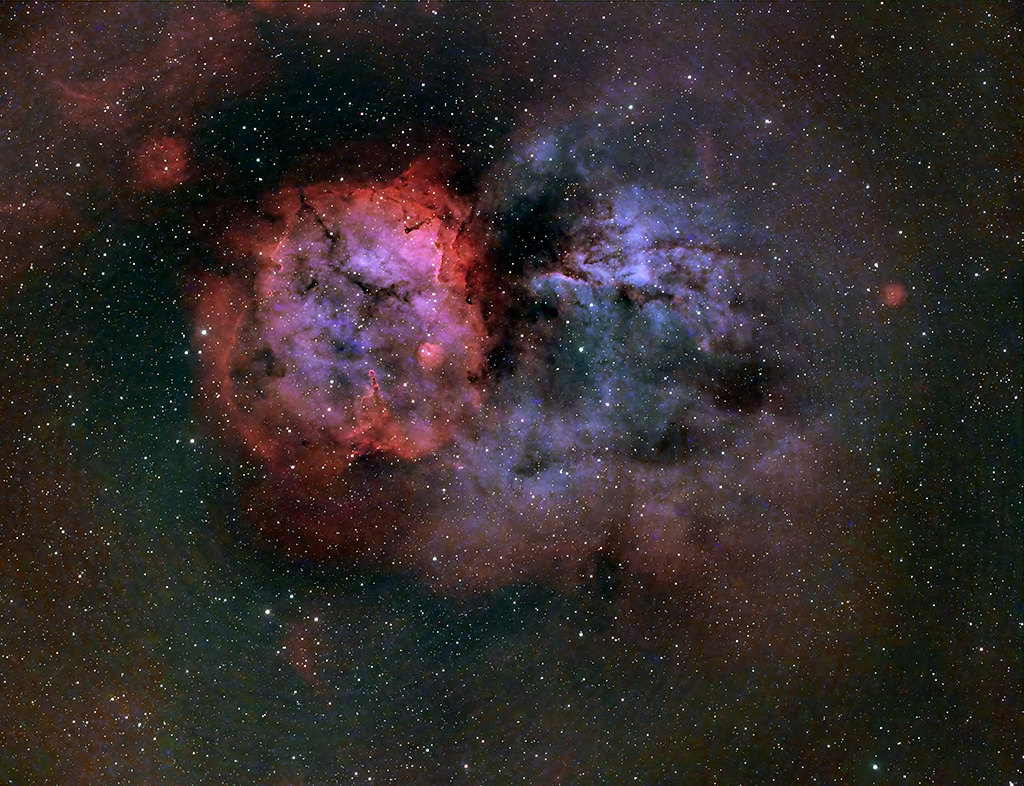
Sh2-284 is a large emission nebula visible in the constellation Unicorn .
It is observed in the east-central part of the constellation, about 5° southeast of the Rosetta Nebula . It can be tracked and photographed through a high-powered amateur telescope equipped with special filters. Situated almost astride the celestial equator , it can be observed from all populated areas of Earth with ease. The most favorable period for its observation in the evening sky is from December to April.
Characteristics
This is a large H II region , the distance of which has long been debated: in the 1980s, a distance of approximately 5,200 pc (∼17,000 ly ) was proposed 1 , thus placing it in a region intermediate between the arm of Perseus and the arm of the Swan . In 2007, thanks to the study of the dynamics of the galactic spiral arms , a distance of approximately 7,890 pc (∼25,700 ly ) was assigned to cloud 2 , therefore in the outermost regions of the Milky Way , on the arm of the Swan, also called the outer arm. The center of the nebula houses the large open cluster Dolidze 25 (Do 25), in fact an OB association composed of a blue giant of spectral class O9 and four more or less massive class B stars, including a subgiant . These five stars, cataloged Cl*Dolidze 25 MV 1, 9, 12, 15 and 17, are also primarily responsible for the ionization of Sh2-284 3 gases . A, to these are added two other possible ionizing stars, cataloged HD 48691 and BD+00 1576, respectively of class B0.5IV and O9III, previously identified.
The stars in the region are all very poor in metals, a relatively common characteristic of stars located in the most distant regions of the Milky Way. Star formation phenomena are also active in the cloud, as evidenced by the presence of a large number of sources of infrared radiation , more than thirty, coinciding with as many very young protostars and pre- main sequence stars . These sources include three water masers and three carbon monoxide (CO) masers 5 . According to a 2007 study, other nebulous regions visible at close range, such as Sh2-283 , Sh2-285 and Sh2-286 , are physically connected to Sh2-2842 .
In the nebula’s line of sight is a tangle of gaseous filaments belonging to a supernova remnant , cataloged as SNR G213.0-00.6. This object is in the foreground, about 2,400 pc (∼7,830 ly ) from the Sun , and would therefore be part of the arm of Perseus 2 . The two objects would therefore not be physically linked.
IMAGING DATA
Provo, Utah
Bortle 5 sky
Date: 10/22/2023
Image: SH 2-284
Camera: ZWO ASI2600 MC Pro in Hyperstar Position
Filter: STC Astro Duo-Narrowband
Temperature: -5 deg C
Gain: 100
Binning: 1×1
Exposure: 180 seconds
# of Lights: 49 for 2 hours 7 minutes
Telescope: Celestron 1100 Edge HD
Hyperstar IV Camera mount
Mount: 10Micron GM1000HPS
Pier: Steel pier on 600 lb concrete block
Observatory: NexDome “Y Mountain Observatory”
Software used
Deep Sky Stacker, Pixinsight, Photoshop