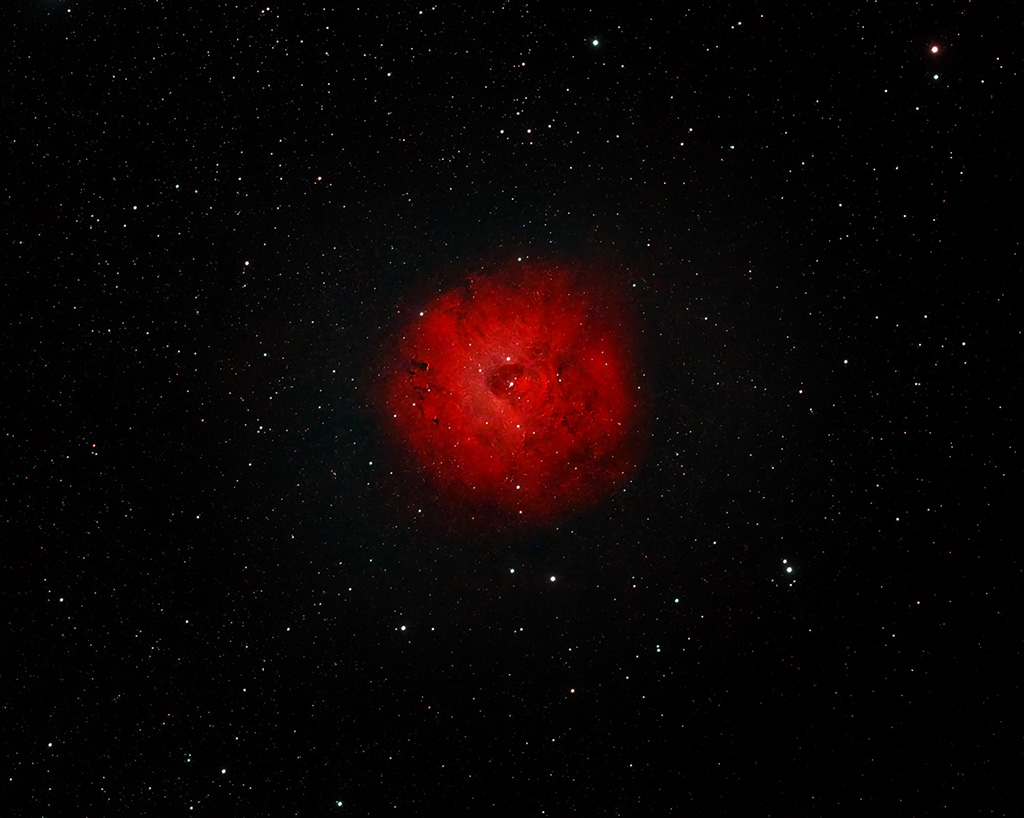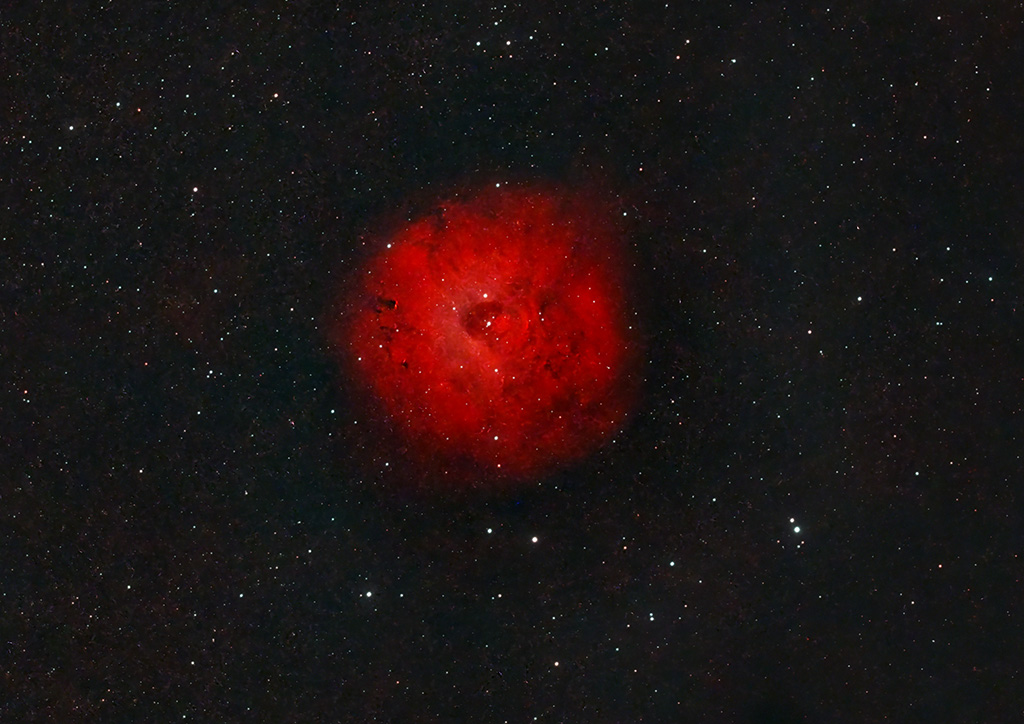
10/27/2023 Sh2-170 is an emission nebula visible in the constellation Cassiopeia
It is located in the northwestern part of the constellation, about 5° north of the star Caph; the most suitable period for its observation in the evening sky falls between the months of August and January and is considerably easier for observers located in the regions of the Earth’s northern hemisphere, where it is circumpolar up to the warm temperate regions.
Sh2-170 is an H II region located on the Perseus Arm about 2300 parsecs (about 7500 light years) away, near the edge of a large superbubble originating from the combined action of the stellar wind of the stellar association Cassiopeia OB5. The one responsible for the ionization of its gases is known by the acronym BD+63 2093; it is a main sequence star with spectral class O9V, part of the small and young open cluster Stock 18. The edges of the ionized region are mostly blurred, indicating a lower density on the periphery, except for the south-eastern side; the ionizing star is located near the center, on the leading edge of a small isolated molecular cloud. It is believed that 40% of the mass of the complex consists of neutral monatomic hydrogen (HI), located beyond the ionization front. The infrared radiation source IRAS 00001+6417, observable in the direction of the nebula, corresponds to a molecular cloud with CO emissions probably located at a higher distance, around 4600 parsecs, although the Avedisova Catalog indicates it as linked to Sh2-170.
IMAGING DATA
Provo, Utah
Bortle 5 sky
Date: 10/26/2023
Image: SH 2-170
Camera: ZWO ASI2600 MC Pro in Hyperstar Position
Filter: STC Astro Duo-Narrowband
Temperature: -5 deg C
Gain: 100
Binning: 1×1
Exposure: 180 seconds
# of Lights: 77 for 3 hours 51 minutes
Telescope: Celestron 1100 Edge HD
Hyperstar IV Camera mount
Mount: 10Micron GM1000HPS
Pier: Steel pier on 600 lb concrete block
Observatory: NexDome “Y Mountain Observatory”
Software used
Deep Sky Stacker, Pixinsight, Photoshop