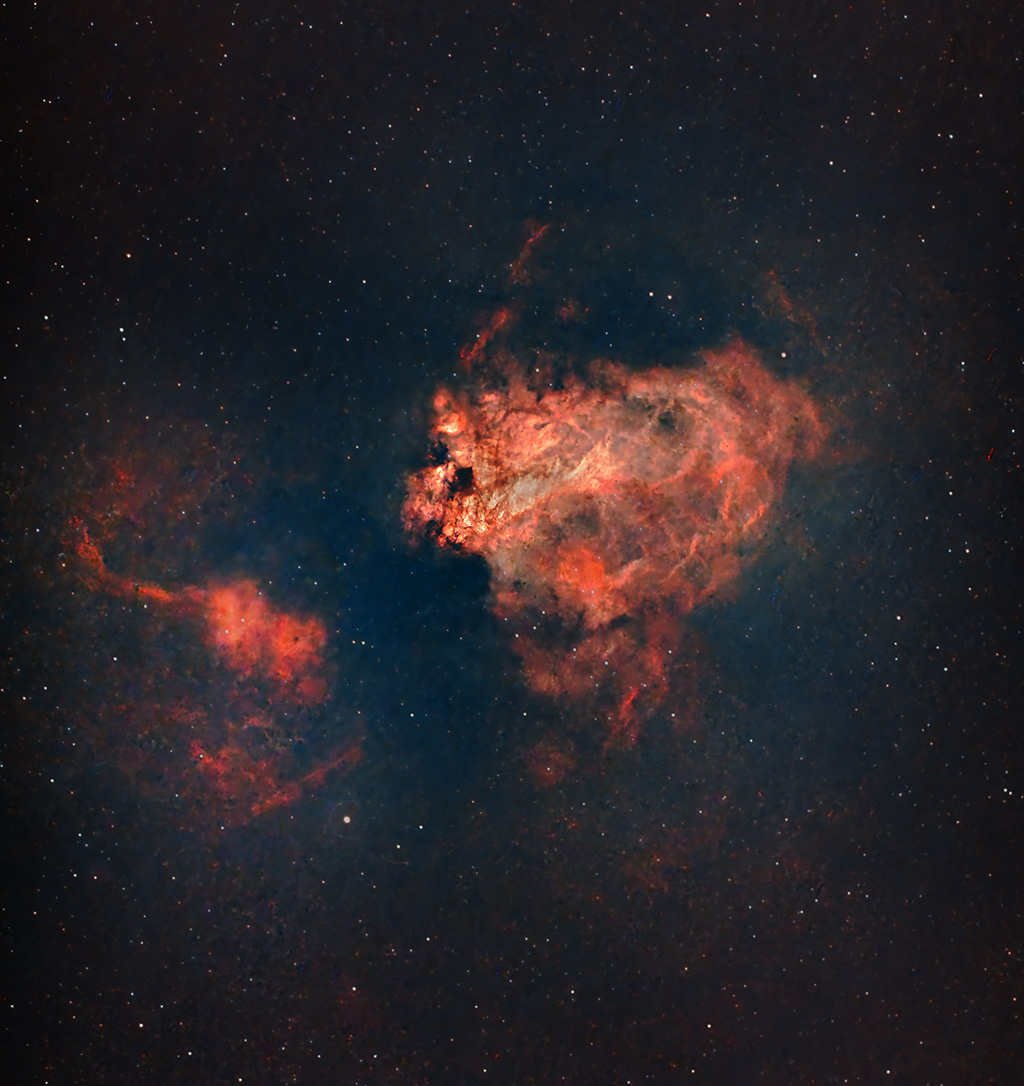
The Omega Nebula is (Messier 17) between 5,000 and 6,000 light-years from Earth and it spans some 15 light-years in diameter. The cloud of interstellar matter of which this nebula is a part is roughly 40 light-years in diameter and has a mass of 30,000 solar masses. The total mass of the Omega Nebula is an estimated 800 solar masses.
It is considered one of the brightest and most massive star-forming regions of our galaxy. Its local geometry is similar to the Orion Nebula except that it is viewed edge-on rather than face-on.
The open cluster NGC 6618 lies embedded in the nebulosity and causes the gases of the nebula to shine due to radiation from these hot, young stars; however, the actual number of stars in the nebula is much higher – up to 800, 100 of spectral type earlier than B9, and 9 of spectral type O, plus over a thousand stars in formation on its outer regions. It is also one of the youngest clusters known, with an age of just 1 million years.
The luminous blue variable HD 168607, located in the south-east part of the Omega nebula, is generally assumed to be associated with it; its close neighbor, the blue hypergiant HD 168625, may be too.
The Swan portion of M17, the Omega Nebula in the Sagittarius nebulosity is said to resemble a barber’s pole. (Wikipedia)
Imaging Data:
Date: 8/14/19
Exposure= 30s x 120 of which 67 were used
Binning = 1×1
Gain + 200
Camera Temperature= 0 deg C
Filter= STC Astro Duo-Narrowband Filter
Camera = ASI294MC PRO in Hyperstar position
Processed in DSS (lights only) then PS