IC 63 OR SH 2-185 The Ghost of Cassiopeia
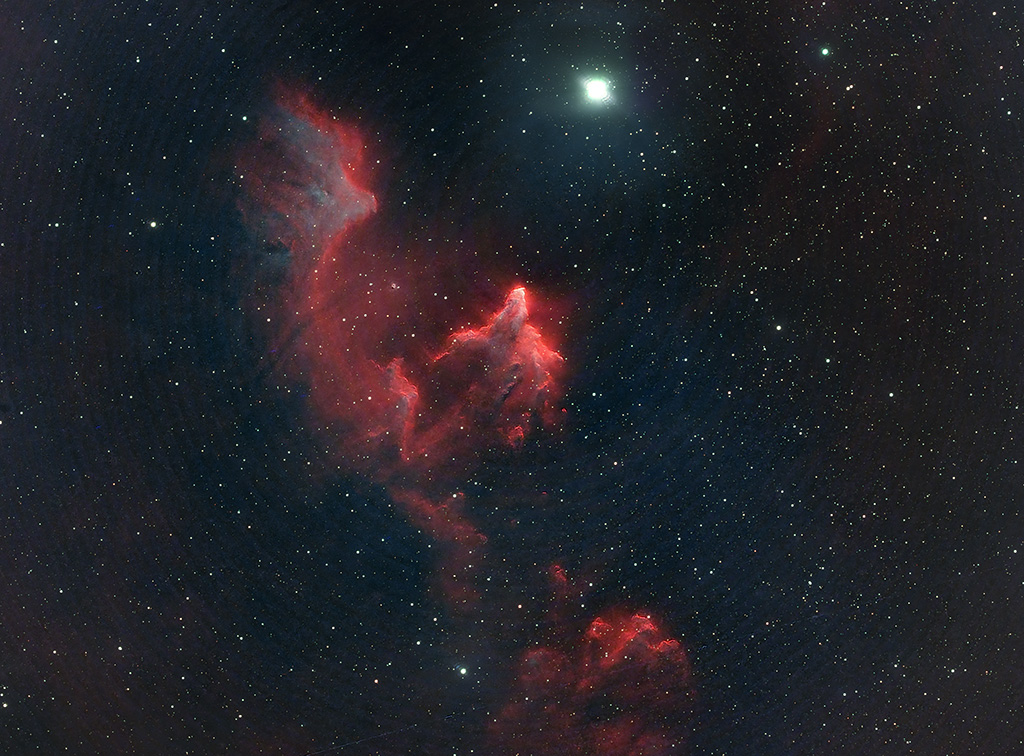
Powerful gushers of energy from seething stars can sculpt eerie-looking figures with long flowing veils of gas and dust. One striking example is "the Ghost of Cassiopeia," officially known as IC 63, located 550 light-years away in the constellation Cassiopeia the Queen.
The nebula’s ethereal glow might remind people of apparitions such as those reported by paranormal investigators. In reality, it's simply hydrogen that is being bombarded with ultraviolet radiation from the nearby, blue-giant star Gamma Cassiopeia (not seen here), causing it to glow in red light. The blue color is from light reflected off of the nebula’s dust.
The IC 63 nebula is not the only object under the influence of the blinding star, which unleashes as much energy as 34,000 suns. The Ghost Nebula is part of a much larger nebulous region surrounding Gamma Cassiopeia that measures approximately two degrees on the sky — roughly four times as wide as the full Moon.
The constellation Cassiopeia is visible every clear night from mid-northern and higher latitudes. Its distinctive "W" asterism, which forms the queen's throne, is best seen high in the sky on autumn and winter evenings. Gamma Cassiopeia, the middle star in the W, is visible to the unaided eye, but a large telescope is needed to see IC 63. HUBBLESITE
Imaging Data:
Provo, Utah
Bortle 5 sky
Image: SH 2-185 OR IC 63
Date 9/6/2023 12/14 & 15/2023
Exposure= 180 seconds
Number of Lights: 167 for 8 hours 21 minutes
Binning = 1×1
Camera Temperature= 0 deg C
Camera Gain= 100
Filter= STC Astro Duo-Narrowband
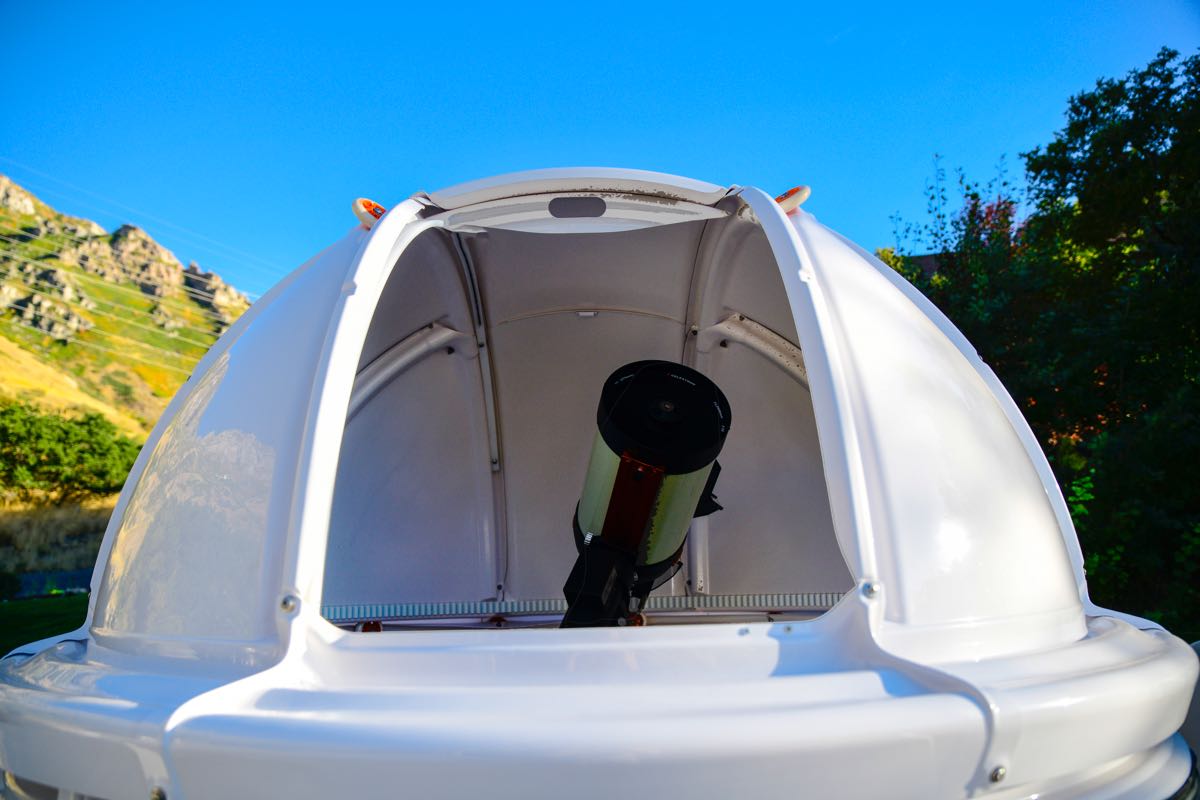
Camera = ZWO AS2600 MC Pro in Hyperstar Position
Telescope: Celestron 1100 Edge HD
Mount: 10Micron GM1000HPS
Processed with DSS, PI and PS
SH 2-124
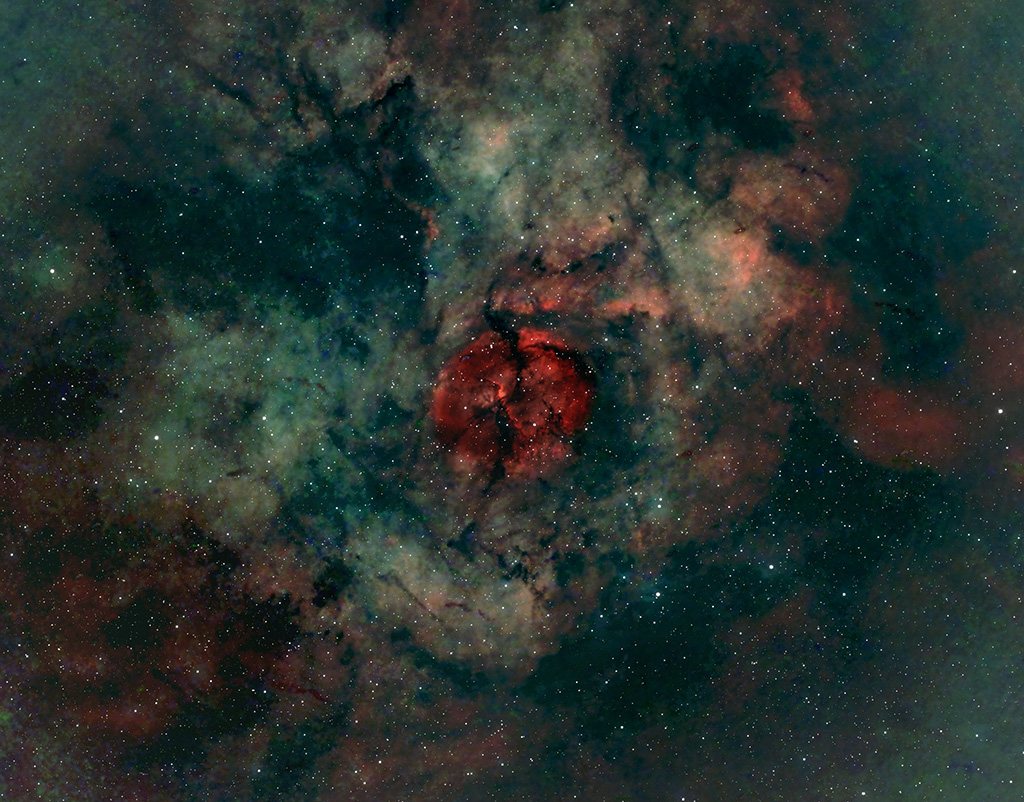
The mysterious HII region Sh 2-124 is located at a distance of about 2600 parsecs towards the northeast edge of the Cygnus complex. Almost nothing has been written about this nebula in the scientific literature. In the DSS2 (Digitized Sky Survey) image shown first you can discern a faint amount of nebulosity around the brighter stars. In the far more detailed IPHAS image shown second, however, Sh 2-124 emerges as a spectacular nebula with dividing dust lanes that might be as famous as the Trifid nebula if it were as bright. Galaxy Map
Imaging Data:
Provo, Utah
Bortle 5 sky
Date September 6-7 ,2023
Image: SH 2-124
Size: 1.3 deg
Magnitude: N/A
Exposure= 180 seconds and 150 lights for a total of 7 hour and 30 minutes
Gain=. 100
Binning = 1×1
Temperature= -5 deg C
Filter= IDAS-NBZ Narrowband Filter
Camera: ASI2600MC PRO in Hyperstar configuration.
Telescope: Celestron 1100 Edge HD
Mount : 10MICRON GM1000HPS
Processed with DSS, PI and PS
8/27/2023
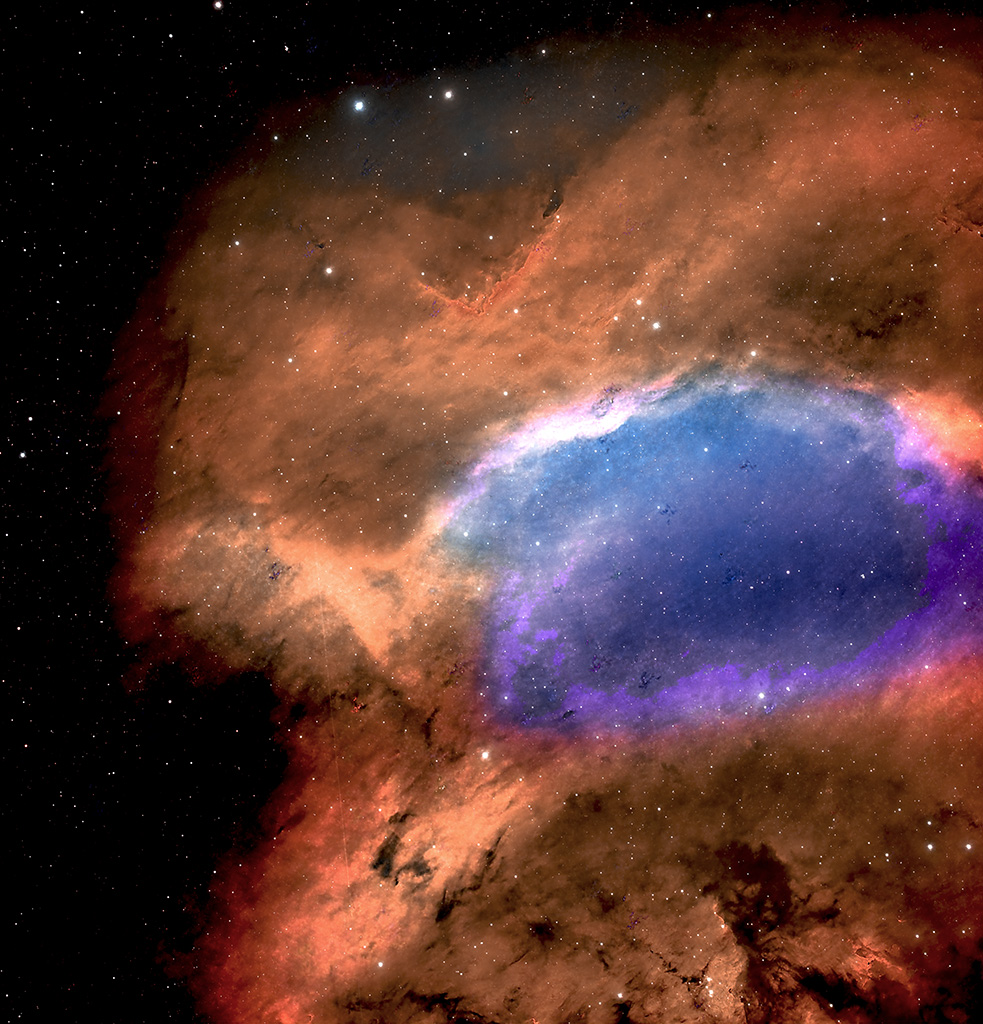
NGC 7822 is a young star forming complex in the constellation of Cepheus. The complex encompasses the emission region designated Sharpless 171, and the young cluster of stars named Berkeley 59. The complex is believed to be some 800-1000 pc distant, with the younger components aged no more than a few million years. The complex also includes one of the hottest stars discovered within 1 kpc of the Sun, namely BD+66 1673, which is an eclipsing binary system consisting of an O5V that exhibits a surface temperature of nearly 45,000 K and a luminosity about 100,000 times that of the Sun. The star is one of the primary sources illuminating the nebula and shaping the complex's famed pillars of creation-type formations, the elephant trunks. Wikipedia
Imaging Data:
Provo, Utah
Bortle 5 sky
Date August 25,26 ,2023
Image: NGC 7822
Size: 20’
Magnitude: N/A
Exposure= 240 seconds and 184 lights for a total of 6 hour and 56 minutes
Gain= 100
Binning = 1×1
Temperature= 0 deg C
Filter= IDAS-NBZ Narrowband Filter
Camera: ASI2600MC PRO in Hyperstar configuration.
Telescope: Celestron 1100 Edge HD
Mount : 10MICRON GM1000HPS
Processed with DSS, PI and PS
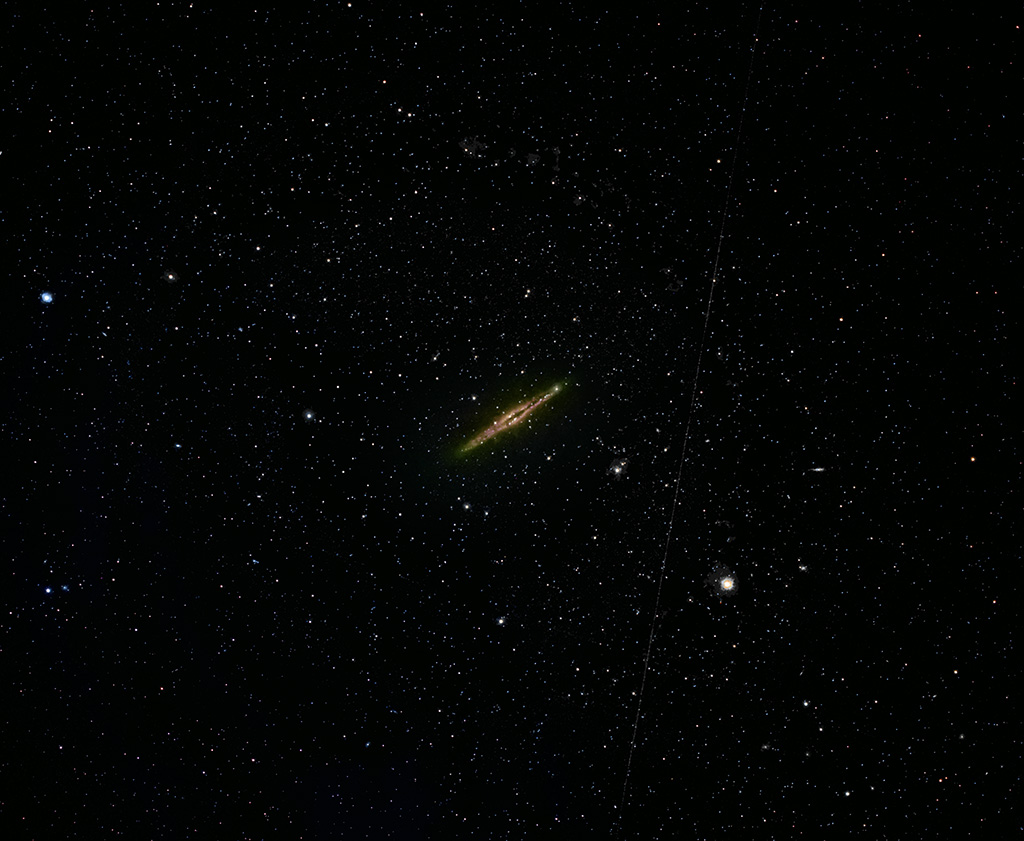
NCG 891
NGC 891 (also known as Caldwell 23 or Silver Sliver Galaxy) is an edge-on unbarred spiral galaxy about 30 million light-years away in the constellation Andromeda. It was discovered by William Herschel on October 6, 1784. The galaxy is a member of the NGC 1023 group of galaxies in the Local Supercluster. It has an H II nucleus.
The object is visible in small to moderate size telescopes as a faint elongated smear of light with a dust lane visible in larger apertures. (WIKIPEDIA)
Imaging Data:
Provo, Utah
Bortle 5 sky
Date: 8/6/2023
Image: NGC 891
Size:= 11.7’
Magnitude= 9.8
Exposure= 180 seconds x 7 for a total 21m
Binning = 1×1
Temperature= 0 deg C
Camera Gain= 100
Filter= IDAS-NBZ Narrowband Filter
Camera: ASI2600MC PRO in Hyperstar IV configuration.
Telescope: Celestron 1100 Edge HD
Mount: 10Micron GM1000HPS
Processed with DSS, PI and PS
9/9/2023
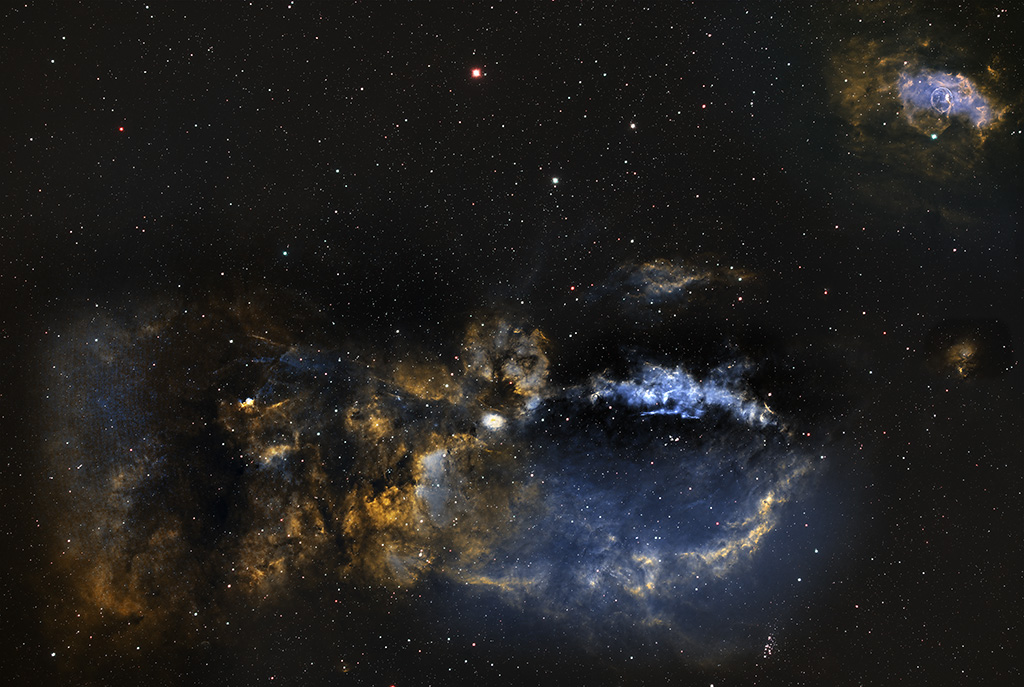
SH 2-157 Lobster Claw Nebula and NGC 7635 Bubble Nebula
Sh2-157 is a nebula with a weak emission but of considerable extension visible in the constellation of Cassiopeia; it is located on the Perseus Arm and is directly connected to the large OB Cassiopeia OB2 association. The northern part of the cloud has a ring shape, caused by the action of the stellar wind of several giant stars, while the southern sector appears excited by the luminous radiation of stars of spectral class O.
Inside it there is a cluster of very young stars, which represents the latest generation of a star formation process that includes the same Cas OB2 association and the nearby open cluster NGC 7510. Wikipedia
NGC 7635, also known as the Bubble Nebula, Sharpless 162, or Caldwell 11, is an H II region emission nebula in the constellation Cassiopeia. It lies close to the direction of the open cluster Messier 52. The "bubble" is created by the stellar wind from a massive hot, 8.7 magnitude young central star, SAO 20575 (BD+60°2522). The nebula is near a giant molecular cloud which contains the expansion of the bubble nebula while itself being excited by the hot central star, causing it to glow. It was discovered in 1787 by William Herschel. Wikipedia
Imaging Data:
Provo, Utah
Bortle 5 sky
Date: 9/8/2023
Exposure= 180s X 136 for 6 hours and 48 minutes
Binning = 1×1
Temperature= 0 deg C
Camera Gain= 100
Filter= IDAS-NBZ Narrowband Filter
Camera: ASI2600MC PRO in Hyperstar IV configuration.
Telescope: Celestron 1100 Edge HD
Mount: 10Micron GM1000HPS
Processed with DSS, PI and PS
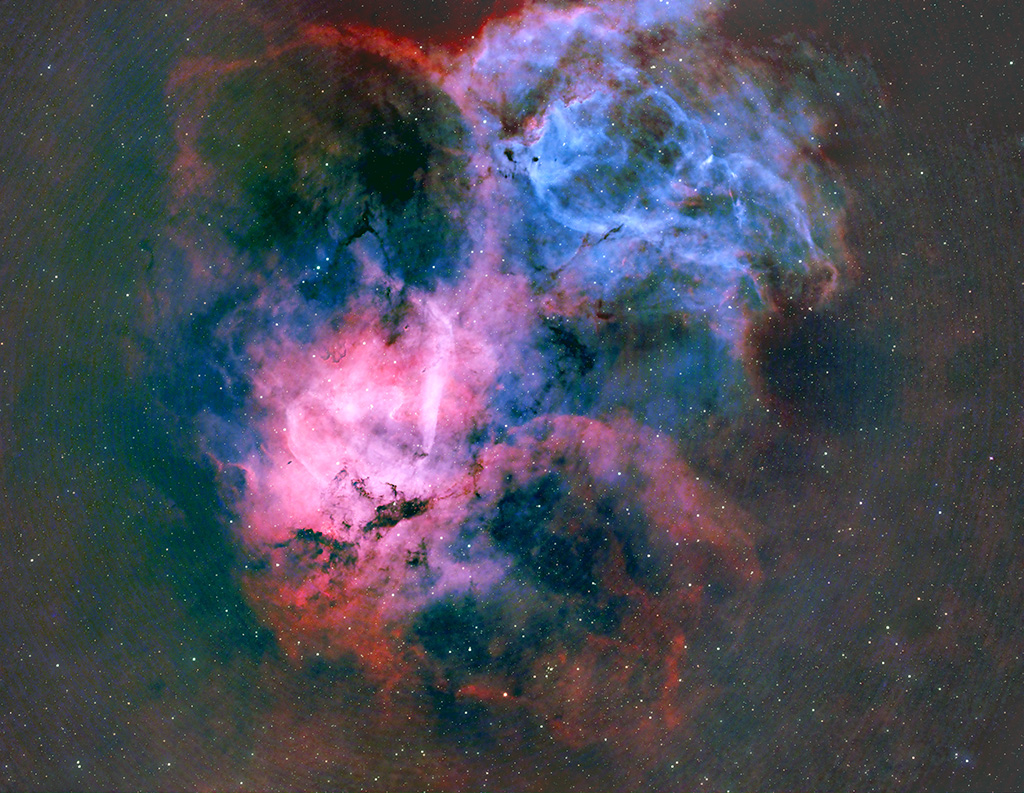
Sh2-132 is a large emission nebula visible in the constellation Cepheus.
It is located on the southern edge of the constellation, a short distance from the boundary with the Lizard, along the plane of the Milky Way; the best period for its observation in the evening sky falls between the months of July and December and is greatly facilitated for observers located in the northern hemisphere regions of Earth.
Sh2-132 is located at a distance of nearly 3200 parsecs (almost 10400 light-years), thus placing it within the Perseus Arm, in the region of Cepheus OB1, a large and bright OB association. The stars responsible for the ionization of its gas are very hot and massive; in particular, two Wolf-Rayet stars have been identified, known as HD 211564 and HD 211853 (the latter also having the abbreviation WR 153), as well as a spectral class O8.5V star and about ten B-class stars. Around the O-class star and one of the Wolf-Rayet stars extends a bubble clearly visible in the radio wave band, identified as Shell B, probably originating from the stellar wind of the two massive stars. A similar but smaller structure, Shell A, hosts a K-class star near its center. Chain star formation processes are believed to have taken place in the nebula in the past; currently these processes appear to be suspended, since there is no evidence of recent activity. Nine sources of infrared radiation and a maser with H2O emissions have been detected in the direction of the nebula.
IMAGING DATA
Provo, Utah
Bortle 5 sky
Date: 9/15&16/2023
Image: SH 2-132
Camera: ZWO ASI2600 MC Pro in Hyperstar Position
Filter: STC Astro Duo-Narrowband
Temperature: -5 deg C
Gain: 100
Binning: 1×1
Exposure: 180 seconds
# of Lights: 267 for 13 hours 21 minutes were used.
Telescope: Celestron 1100 Edge HD
Hyperstar IV Camera mount
Mount: 10Micron GM1000HPS
Pier: Steel pier on 600 lb concrete block
Observatory: NexDome “Y Mountain Observatory”
Software used
Deep Sky Stacker, Pixinsight, Photoshop
CED 214 (Cederbad 214)
Cederbad 214 (NGC 7822) is a young star forming complex in the constellation of Cepheus. The complex encompasses the emission region designated Sharpless 171, and the young cluster of stars named Berkeley 59. The complex is believed to be some 800-1000 pc distant, with the younger components aged no more than a few million years. The complex also includes one of the hottest stars discovered within 1 kpc of the Sun, namely BD+66 1673, which is an eclipsing binary system consisting of an O5V that exhibits a surface temperature of nearly 45,000 K and a luminosity about 100,000 times that of the Sun. The star is one of the primary sources illuminating the nebula and shaping the complex's famed pillars of creation-type formations, the elephant trunks. Wikipedia
IMAGING DATA
Provo, Utah
Bortle 5 sky
Date: 9/23/2023
Image: CED 214
Camera: ZWO ASI2600 MC Pro in Hyperstar Position
Filter: STC Astro Duo-Narrowband
Temperature: -10 deg C
Gain: 100
Binning: 1×1
Exposure: 180 seconds
# of Lights: 158 for 7 hours 54 minutes were used.
Telescope: Celestron 1100 Edge HD
Hyperstar IV Camera mount
Mount: 10Micron GM1000HPS
Pier: Steel pier on 600 lb concrete block
Observatory: NexDome “Y Mountain Observatory”
Software used
Deep Sky Stacker, Pixinsight, Photoshop
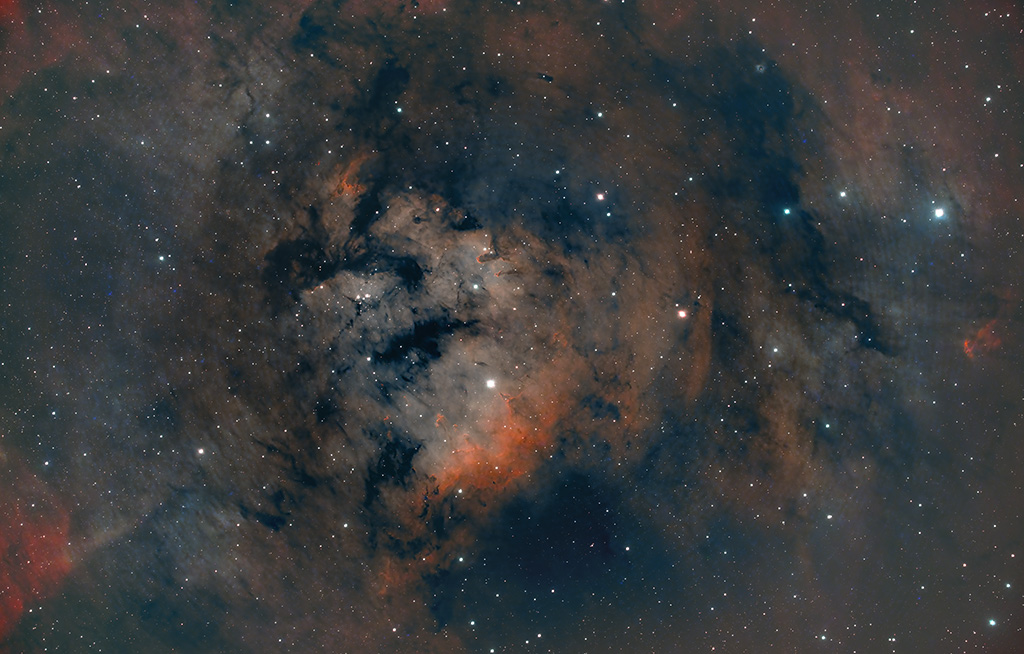
Here is a cropped version of the above pic:
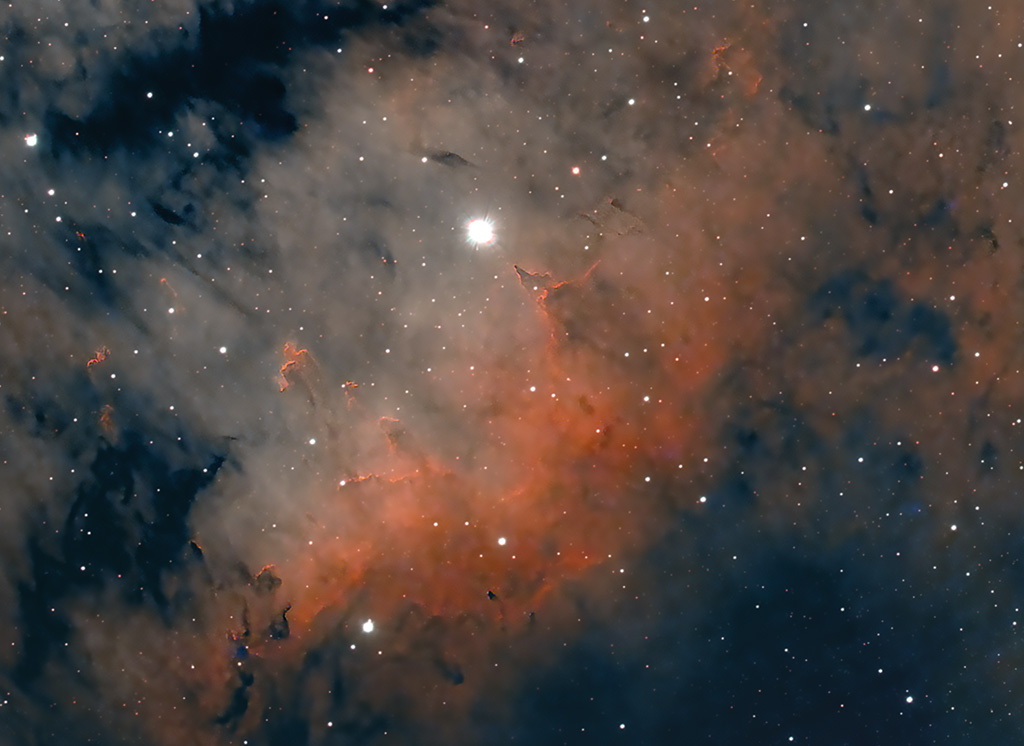
10/2/2023. SH 2-115
Sh2-115 is an emission nebula visible in the constellation Cygnus.
It is located in the northern part of the constellation, about 2.5° northwest of the bright star Deneb; the most suitable period for its observation in the evening sky falls between the months of July and December and is considerably easier for observers located in the regions of the Earth's northern hemisphere.
It is a H II region of considerable extension with an oval shape and crossed in a northwest-southeast direction by a dark band that apparently divides it into two equal parts: the eastern part is dominated by the presence of a small open cluster, known as Berkeley 90 , with which it is physically associated, while the western part lies in the direction of the variable star α2 CVn HD 196178 (V2015 Cyg), with an average apparent magnitude of 5.63; however, the distance of this star from the Sun is equal to just 148 parsecs (481 light years), significantly lower than that estimated for the nebula, approximately 2300 parsecs (7500 light years). The stars responsible for the ionization of the gas are LS III +46 12, of spectral class O6III, DM46 2972, of class O9.5V, and DM46 2978, of class B0III; the first of these dominates the Berkeley 90 cluster.[2] The star BD+46 2972 also appears in the same field, but its distance is greater than the nebula, therefore its physical relationship with it would be excluded.
Sh2-115 corresponds to the ionized part of a large molecular cloud whose mass has been estimated at approximately 4400 M⊙, extending for over 30 parsecs. According to the Avedisova catalog, the star formation region to which this nebula belongs also includes several sources of infrared radiation observable in its direction, such as IRAS 20328+4639, IRAS 20334+4636, IRAS 20335+4637 and IRAS 20334+4654, identified in during the eighties; to these is added the W71 radio wave source. Its distance of 2300 parsecs corresponds to a region of the Orion Arm located just beyond the large nebulous system of Cygnus. Wikipedia
IMAGING DATA
Provo, Utah
Bortle 5 sky
Date: 9/24/2023
Image: SH 2-115
Camera: ZWO ASI2600 MC Pro in Hyperstar Position
Filter: STC Astro Duo-Narrowband
Temperature: -5 deg C
Gain: 100
Binning: 1×1
Exposure: 180 seconds
# of Lights: 103 for 5 hours 9 minutes
Telescope: Celestron 1100 Edge HD
Hyperstar IV Camera mount
Mount: 10Micron GM1000HPS
Pier: Steel pier on 600 lb concrete block
Observatory: NexDome “Y Mountain Observatory”
Software used
Deep Sky Stacker, Pixinsight, Photoshop
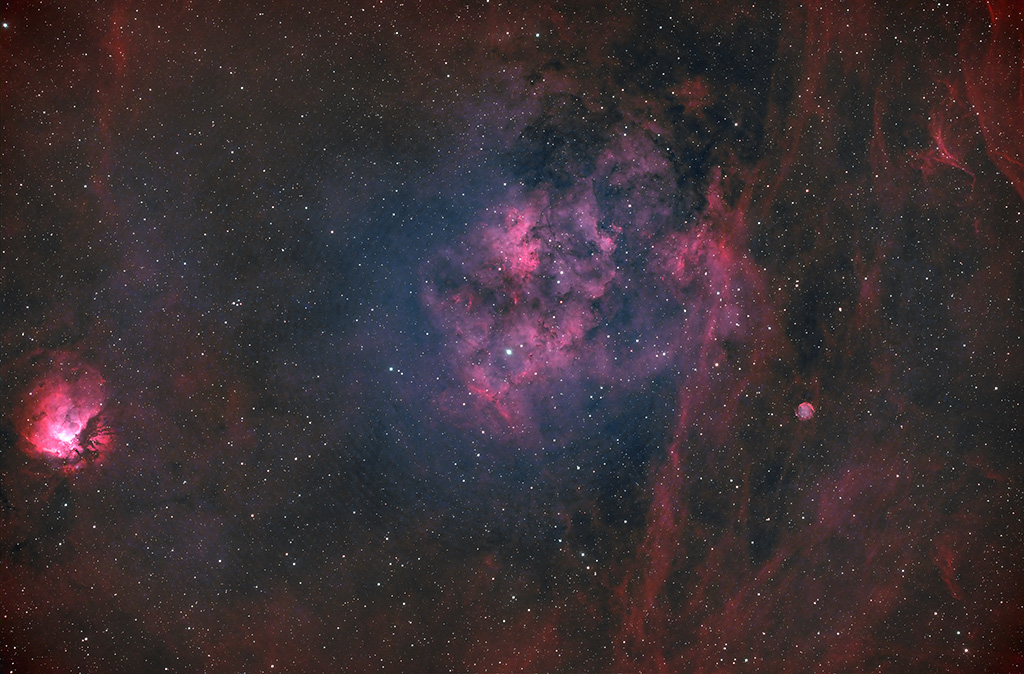
10/3/2023. Sh2-119 is a diffuse nebula observable in the constellation Cygnus.
It is located about 2 degrees west of the North America Nebula, or 9 degrees west of the bright star Deneb; it appears to envelop the star 68 Cygni, of fifth magnitude. It can be observed with a medium-power amateur telescope and shows itself very well in long-exposure photographs.
Its shape appears similar to two shells that are arranged to the east and west of 68 Cygni; the eastern part is the largest. In the southern part, thin filaments and cocoons of dark nebulosity are visible, which contrast strongly both with the light of the nebula and with the rich star field in the background. The distance of Sh2-119 is estimated at 2200 light years from us. Wikipedia
IMAGING DATA
Provo, Utah
Bortle 5 sky
Date: 9/25/2023
Image: SH 2-119
Camera: ZWO ASI2600 MC Pro in Hyperstar Position
Filter: STC Astro Duo-Narrowband
Temperature: -5 deg C
Gain: 100
Binning: 1×1
Exposure: 180 seconds
# of Lights: 108 for 5 hours 24 minutes
Telescope: Celestron 1100 Edge HD
Hyperstar IV Camera mount
Mount: 10Micron GM1000HPS
Pier: Steel pier on 600 lb concrete block
Observatory: NexDome “Y Mountain Observatory”
Software use
Deep Sky Stacker, Pixinsight, Photoshop
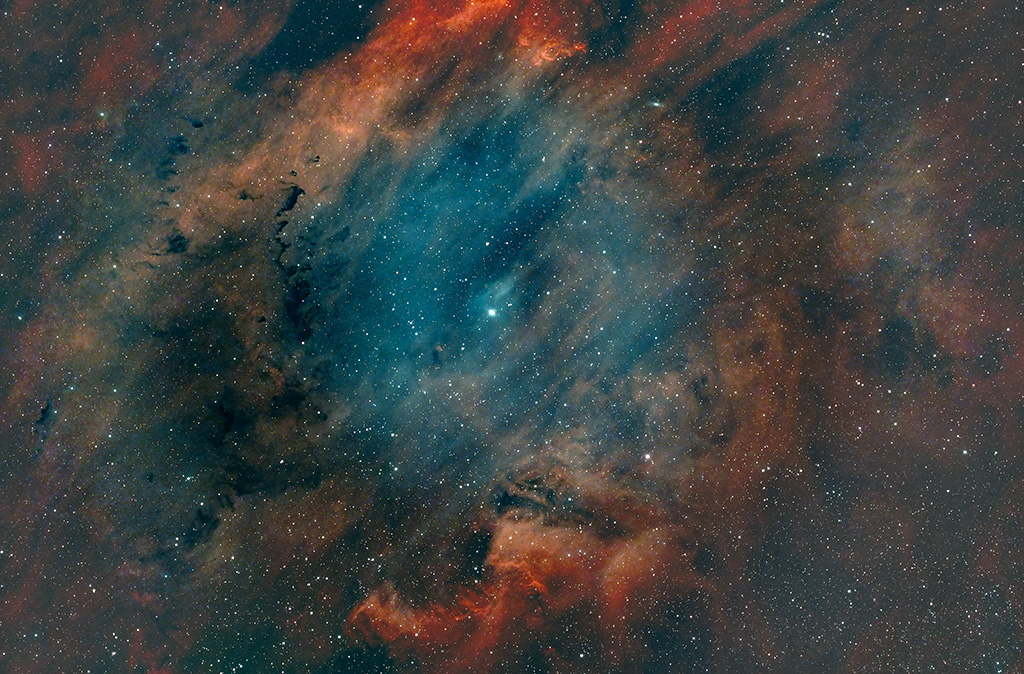
10/4/2023
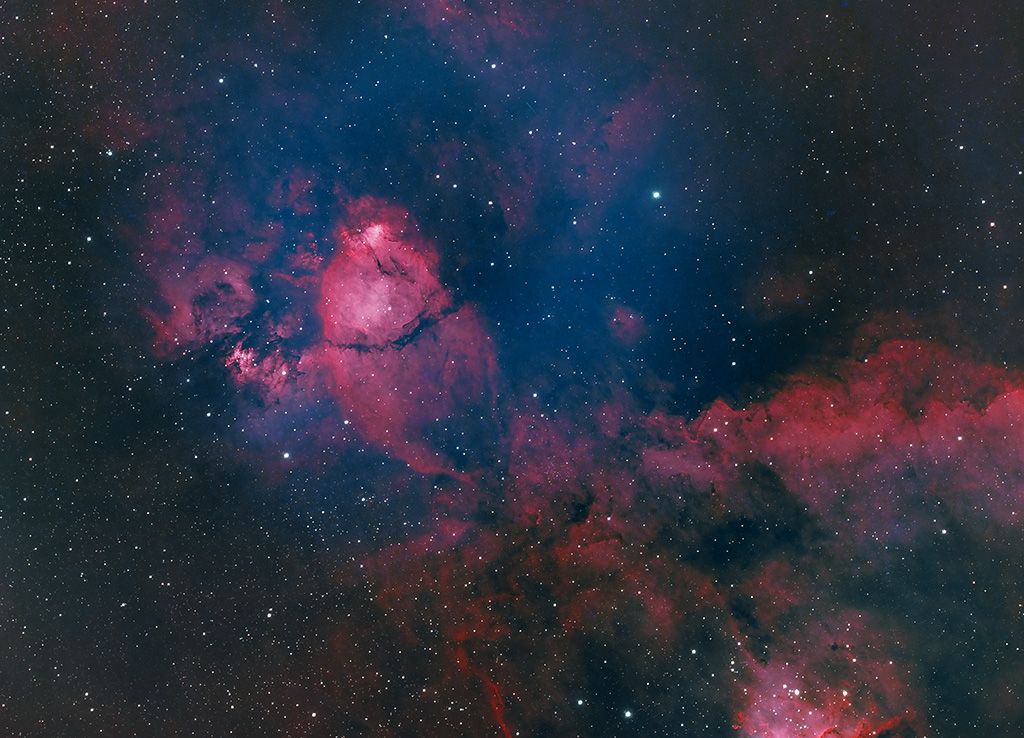
IC 1795 , also nicknamed the Fishhead Nebula 3 , is an emission nebula located approximately 6,000 light years away in the constellation Cassiopeia . It was discovered by the American astronomer Edward Barnard towards the end of the year 1890.
Close to the Perseus Double Cluster and the Heart Nebula in Earth's sky , this complex extends across the Perseus Arm of our Galaxy, the Milky Way, and measures approximately 70 light years across.
It is quite easy to observe and is located in an environment very rich in stars with neighbors IC 1805 and IC 1848 , as well as numerous open clusters.
IMAGING DATA
Provo, Utah
Bortle 5 sky
Date: 9/28/2023
Image: IC 1795
Camera: ZWO ASI2600 MC Pro in Hyperstar Position
Filter: STC Astro Duo-Narrowband
Temperature: -5 deg C
Gain: 100
Binning: 1×1
Exposure: 180 seconds
# of Lights: 137 for 6 hours 51 minutes
Telescope: Celestron 1100 Edge HD
Hyperstar IV Camera mount
Mount: 10Micron GM1000HPS
Pier: Steel pier on 600 lb concrete block
Observatory: NexDome “Y Mountain Observatory”
Software used
Deep Sky Stacker, Pixinsight, Photoshop
10/10/2023
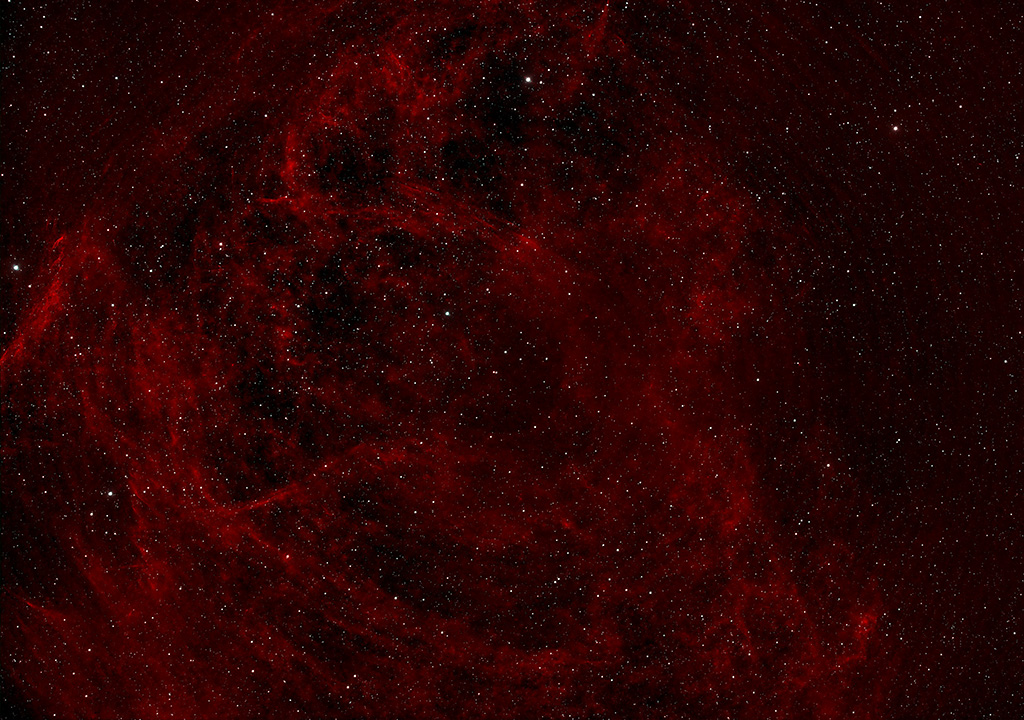
SH 2-221
The Medusa Nebula is a planetary nebula in the constellation of Gemini. It is also known as Abell 21 and Sharpless 2-274. It was originally discovered in 1955 by University of California, Los Angeles astronomer George O. Abell, who classified it as an old planetary nebula. Until the early 1970s, the nebula was thought to be a supernova remnant. With the computation of expansion velocities and the thermal character of the radio emission, Soviet astronomers in 1971 concluded that it was most likely a planetary nebula. As the nebula is so large, its surface brightness is very low, with surface magnitudes of between +15.99 and +25 reported. WIKIPEDIA
IMAGING DATA
Provo, Utah
Bortle 5 sky
Date: 10/7&8/2023
Image: SH 2-221
Camera: ZWO ASI2600 MC Pro in Hyperstar Position
Filter: STC Astro Duo-Narrowband
Temperature: -5 deg C
Gain: 100
Binning: 1×1
Exposure: 180 seconds
# of Lights: 65 for 3 hours 15 minutes were used.
Telescope: Celestron 1100 Edge HD
Hyperstar IV Camera mount
Mount: 10Micron GM1000HPS
Pier: Steel pier on 600 lb concrete block
Observatory: NexDome “Y Mountain Observatory”
Software used
Deep Sky Stacker, Pixinsight, Photoshop
10/23/2023
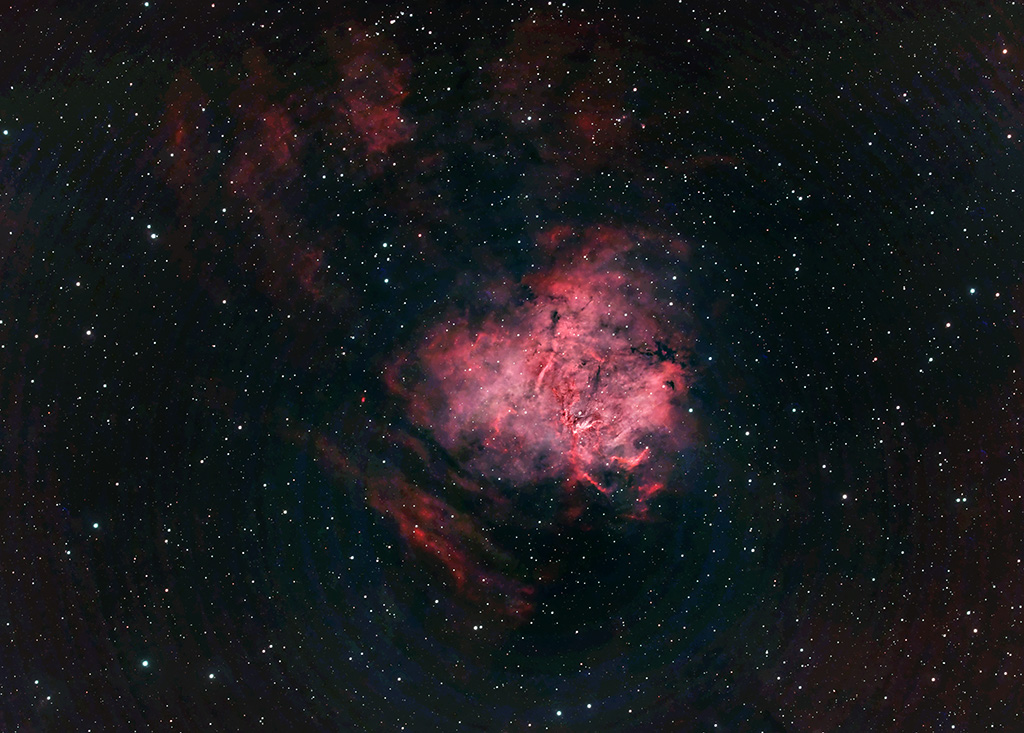
SH 2-206
NGC 1491 (also designated SH2-206 and LBN 704) is a bright emission nebula and HII region, located on the edge of a vast cloud region of neutral gas, about 10,700 light-years away in the Perseus arm of our Milky Way Galaxy in the constellation Perseus.
IMAGING DATA
Provo, Utah
Bortle 5 sky
Date: 10/18/2023
Image: SH 2-206
Camera: ZWO ASI2600 MC Pro in Hyperstar Position
Filter: STC Astro Duo-Narrowband
Temperature: -5 deg C
Gain: 100
Binning: 1×1
Exposure: 180 seconds
# of Lights: 139 for 6 hours 57 minutes
Telescope: Celestron 1100 Edge HD
Hyperstar IV Camera mount
Mount: 10Micron GM1000HPS
Pier: Steel pier on 600 lb concrete block
Observatory: NexDome “Y Mountain Observatory”
Software used
Deep Sky Stacker, Pixinsight, Photoshop
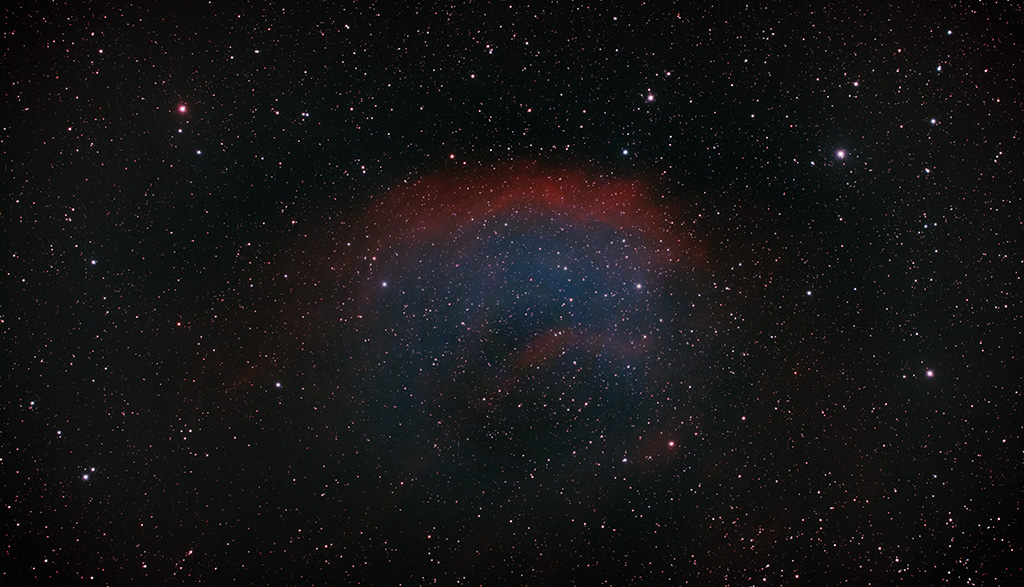
Sh2-216 is one of the closest planetary nebulae to us, with a distance of 420 light years. It is also one of the largest in terms of appearance from us because of its closeness, taking up most of the frame of my SV70T scope (reduced), with actual estimated dimensions ranging from 9-30 light years. The nebula is estimated to be 600,000 years old, formed out of the remnants of a white dwarf. Wikipedia
IMAGING DATA
Provo, Utah
Bortle 5 sky
Date: 10/20/2023
Image: SH 2-206
Camera: ZWO ASI2600 MC Pro in Hyperstar Position
Filter: STC Astro Duo-Narrowband
Temperature: -5 deg C
Gain: 100
Binning: 1×1
Exposure: 180 seconds
# of Lights: 104 for 5 hours 12 minutes
Telescope: Celestron 1100 Edge HD
Hyperstar IV Camera mount
Mount: 10Micron GM1000HPS
Pier: Steel pier on 600 lb concrete block
Observatory: NexDome “Y Mountain Observatory”
Software used
Deep Sky Stacker, Pixinsight, Photoshop
The galaxies of Abell 2666 lie far beyond the Milky Way, some 340 million light-years distant toward the high flying constellation Pegasus. Framed in this sharp telescopic image, the pretty cluster galaxies are gathered behind scattered, spiky, Milky Way stars. At cluster center is giant elliptical galaxy NGC 7768, the central dominant galaxy of the cluster. As the cluster forms, such massive galaxies are thought to grow by mergers of galaxies that fall through the center of the cluster's gravitational well. Typical of dominant cluster galaxies, NGC 7768 likely harbors a supermassive black hole. At the estimated distance of Abell 2666, this cosmic frame would span about 5 million light-years. NASA
IMAGING DATA
Provo, Utah
Bortle 5 sky
Date: 10/20/2023
Image: ABELL 2666
Camera: ZWO ASI2600 MC Pro in Hyperstar Position
Filter: STC Astro Duo-Narrowband
Temperature: -5 deg C
Gain: 100
Binning: 1×1
Exposure: 180 seconds
# of Lights: 123 for 6 hours 6 minutes
Telescope: Celestron 1100 Edge HD
Hyperstar IV Camera mount
Mount: 10Micron GM1000HPS
Pier: Steel pier on 600 lb concrete block
Observatory: NexDome “Y Mountain Observatory”
Software used
Deep Sky Stacker, Pixinsight, Photoshop
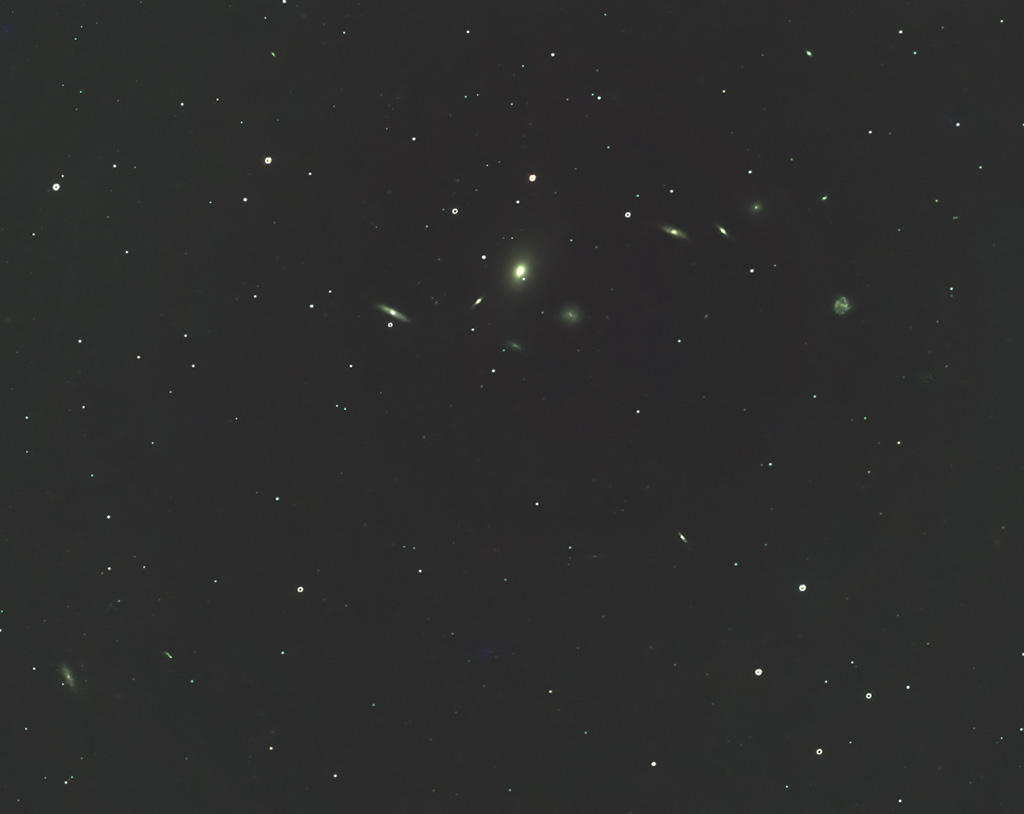
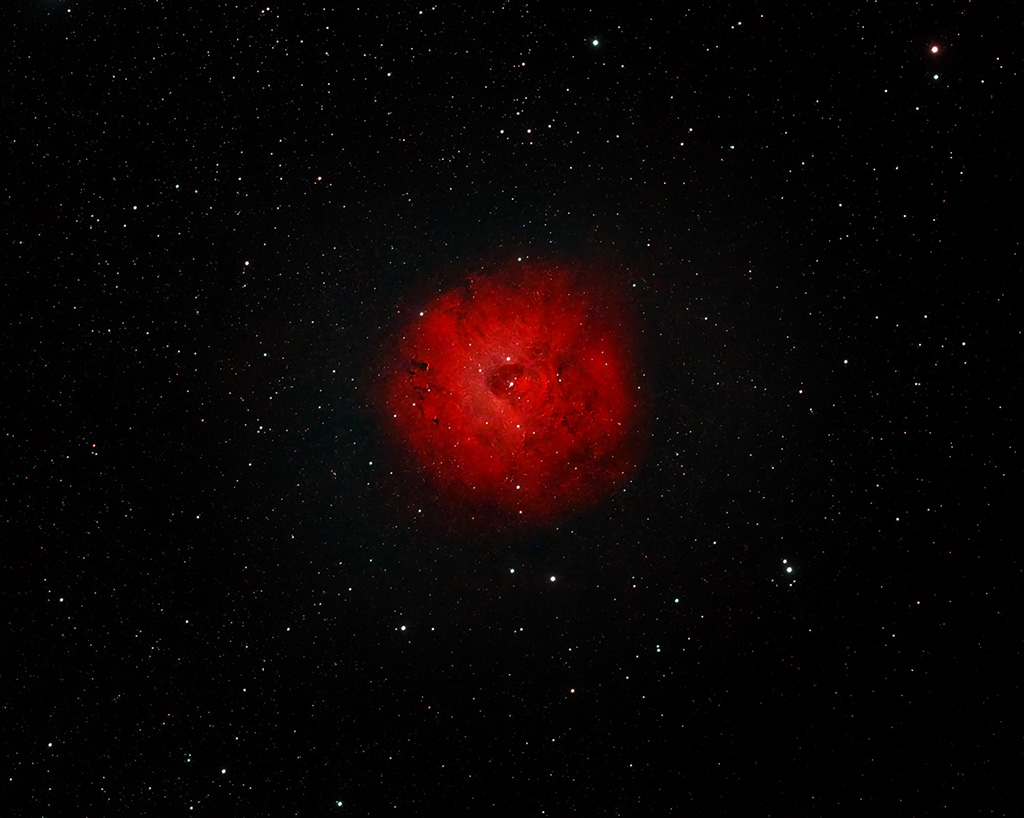
Sh2-284 is a large emission nebula visible in the constellation Unicorn .
It is observed in the east-central part of the constellation, about 5° southeast of the Rosetta Nebula . It can be tracked and photographed through a high-powered amateur telescope equipped with special filters. Situated almost astride the celestial equator , it can be observed from all populated areas of Earth with ease. The most favorable period for its observation in the evening sky is from December to April.
Characteristics
This is a large H II region , the distance of which has long been debated: in the 1980s, a distance of approximately 5,200 pc (∼17,000 ly ) was proposed 1 , thus placing it in a region intermediate between the arm of Perseus and the arm of the Swan . In 2007, thanks to the study of the dynamics of the galactic spiral arms , a distance of approximately 7,890 pc (∼25,700 ly ) was assigned to cloud 2 , therefore in the outermost regions of the Milky Way , on the arm of the Swan, also called the outer arm. The center of the nebula houses the large open cluster Dolidze 25 (Do 25), in fact an OB association composed of a blue giant of spectral class O9 and four more or less massive class B stars, including a subgiant . These five stars, cataloged Cl*Dolidze 25 MV 1, 9, 12, 15 and 17, are also primarily responsible for the ionization of Sh2-284 3 gases . A, to these are added two other possible ionizing stars, cataloged HD 48691 and BD+00 1576, respectively of class B0.5IV and O9III, previously identified.
The stars in the region are all very poor in metals, a relatively common characteristic of stars located in the most distant regions of the Milky Way. Star formation phenomena are also active in the cloud, as evidenced by the presence of a large number of sources of infrared radiation , more than thirty, coinciding with as many very young protostars and pre- main sequence stars . These sources include three water masers and three carbon monoxide (CO) masers 5 . According to a 2007 study, other nebulous regions visible at close range, such as Sh2-283 , Sh2-285 and Sh2-286 , are physically connected to Sh2-2842 .
In the nebula's line of sight is a tangle of gaseous filaments belonging to a supernova remnant , cataloged as SNR G213.0-00.6. This object is in the foreground, about 2,400 pc (∼7,830 ly ) from the Sun , and would therefore be part of the arm of Perseus 2 . The two objects would therefore not be physically linked.
IMAGING DATA
Provo, Utah
Bortle 5 sky
Date: 10/22/2023
Image: SH 2-284
Camera: ZWO ASI2600 MC Pro in Hyperstar Position
Filter: STC Astro Duo-Narrowband
Temperature: -5 deg C
Gain: 100
Binning: 1×1
Exposure: 180 seconds
# of Lights: 49 for 2 hours 7 minutes
Telescope: Celestron 1100 Edge HD
Hyperstar IV Camera mount
Mount: 10Micron GM1000HPS
Pier: Steel pier on 600 lb concrete block
Observatory: NexDome “Y Mountain Observatory”
Software used
Deep Sky Stacker, Pixinsight, Photoshop
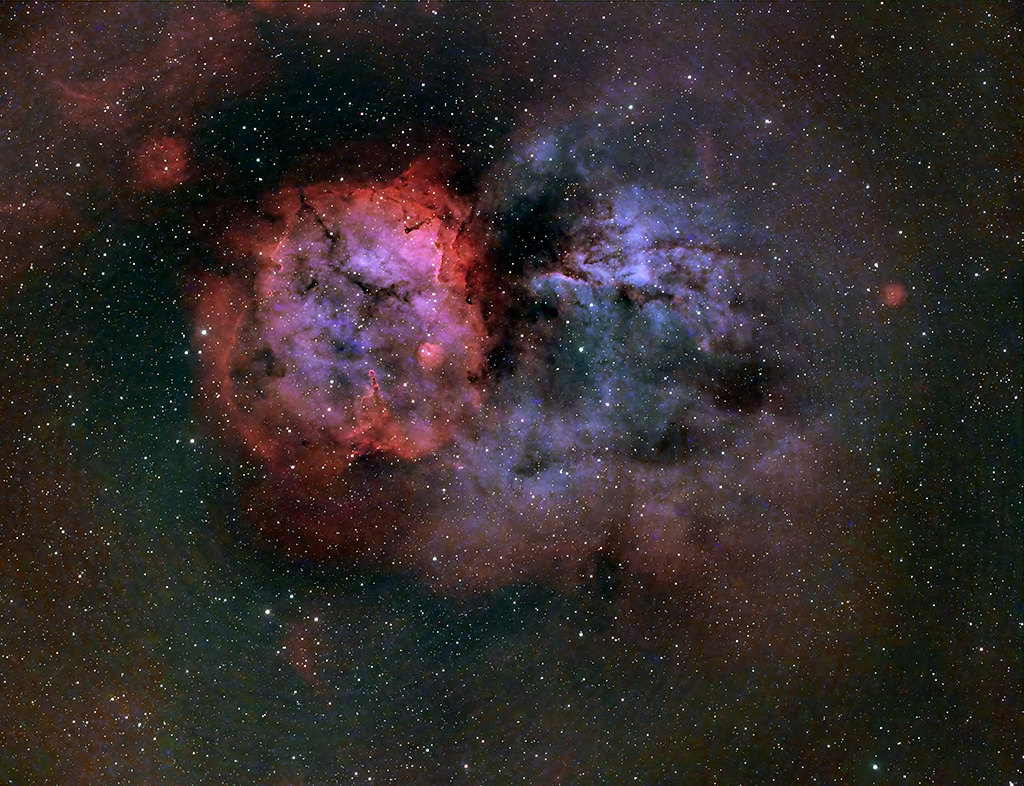
10/27/2023 Sh2-170 is an emission nebula visible in the constellation Cassiopeia
It is located in the northwestern part of the constellation, about 5° north of the star Caph; the most suitable period for its observation in the evening sky falls between the months of August and January and is considerably easier for observers located in the regions of the Earth's northern hemisphere, where it is circumpolar up to the warm temperate regions.
Sh2-170 is an H II region located on the Perseus Arm about 2300 parsecs (about 7500 light years) away, near the edge of a large superbubble originating from the combined action of the stellar wind of the stellar association Cassiopeia OB5. The one responsible for the ionization of its gases is known by the acronym BD+63 2093; it is a main sequence star with spectral class O9V, part of the small and young open cluster Stock 18. The edges of the ionized region are mostly blurred, indicating a lower density on the periphery, except for the south-eastern side; the ionizing star is located near the center, on the leading edge of a small isolated molecular cloud. It is believed that 40% of the mass of the complex consists of neutral monatomic hydrogen (HI), located beyond the ionization front. The infrared radiation source IRAS 00001+6417, observable in the direction of the nebula, corresponds to a molecular cloud with CO emissions probably located at a higher distance, around 4600 parsecs, although the Avedisova Catalog indicates it as linked to Sh2-170.
IMAGING DATA
Provo, Utah
Bortle 5 sky
Date: 10/26/2023
Image: SH 2-170
Camera: ZWO ASI2600 MC Pro in Hyperstar Position
Filter: STC Astro Duo-Narrowband
Temperature: -5 deg C
Gain: 100
Binning: 1×1
Exposure: 180 seconds
# of Lights: 77 for 3 hours 51 minutes
Telescope: Celestron 1100 Edge HD
Hyperstar IV Camera mount
Mount: 10Micron GM1000HPS
Pier: Steel pier on 600 lb concrete block
Observatory: NexDome “Y Mountain Observatory”
Software used
Deep Sky Stacker, Pixinsight, Photoshop
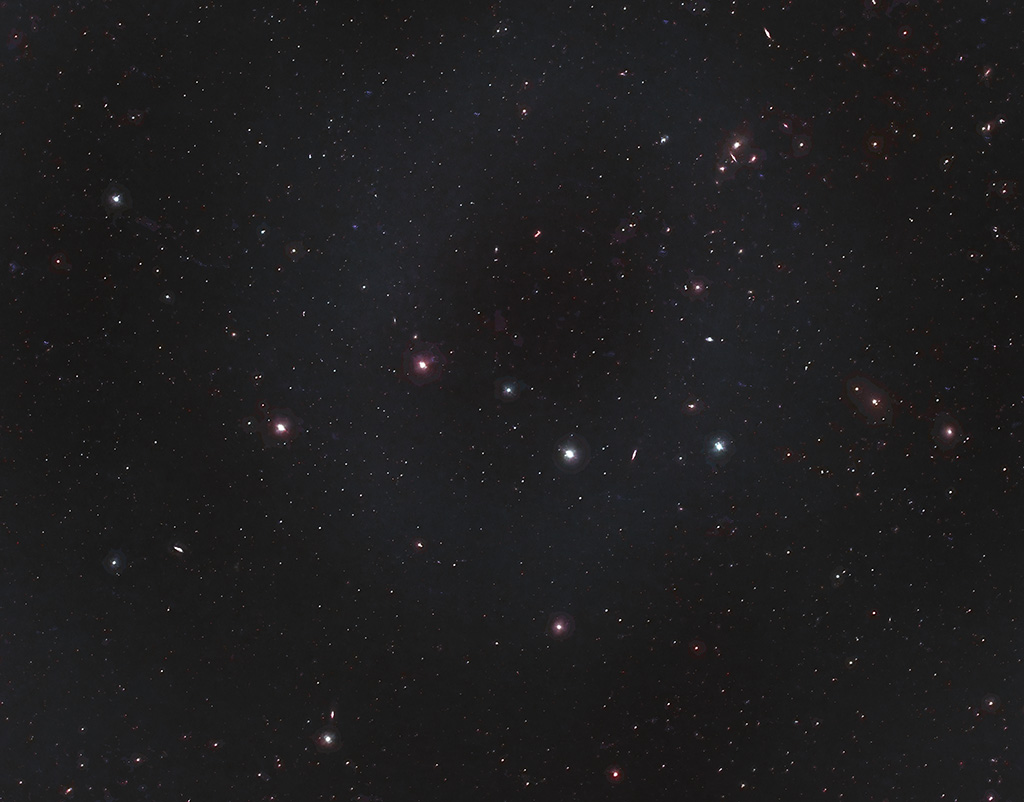
10/31/2023 Abell 262 is a galaxy cluster in the Abell catalogue. It is part of the Perseus-Pisces Supercluster, one of the largest known structures in the universe. Although its central galaxy, NGC 708, is a giant cD galaxy, most of its bright galaxies are spirals, which is unusual for a galaxy cluster. With approximately 200 members it is a comparatively small cluster. Wikipedia
Abell 262 has been extensively studied in X-rays and in the radio continuum. It is a spiral-rich galaxy cluster, characterized by the presence of a central X-ray source centered on a 'cluster dominant' Elliptical Galaxy, NGC 708. These characteristics are similar to those of the closer and more famous Virgo galaxy cluster. Abell 262 is one of the more conspicuous concentrations of galaxies in the Pisces-Perseus super-cluster (a cluster of galaxy clusters consisting of thousands of galaxies).
Using the red shift data from the “NASA Extra-galactic Data Base(NED)”, (and a Hubble Constant of 62 Km per sec., per Megaparsec), one can calculate a rough distance estimate for the Abell Galaxy Cluster of about 260 million light years.
Elliptical Galaxy NGC 708, the 'heart' of Abell 262:
NGC 708 is classified as a 'cluster dominant' Elliptical Galaxy, (M-87 type). These galaxies are several times larger and more massive than any other galaxy. One, or sometimes a pair, of these giants often occupies the very center of a galaxy cluster. Like many others of its type, NGC 708 has a central dust ring and a Seyfert Type II Active Galactic Nucleus (AGN). Astronomers believe that AGNs result from a super massive black hole at the center of a galaxy devouring stars, gas, and dust. One theory suggests that "cluster dominant" ellipticals are the result of the merging of a number of galaxies. Any galaxy now unlucky enough to wander into the central regions of the galaxy cluster will be "cannibalized" by this giant elliptical at the center.
Galaxies NGC 703, NGC 704, NGC 705, NGC 709, NGC 710 and others:
There are about 14 galaxies in the Kopernik picture of the center of Abell 262, all with about the same red shift, and are thus likely cluster members. Most are dwarf ellipticals. However, NGC 705 is probably an edge-on spiral galaxy, and NGC 704 is a pair of Elliptical Galaxies with at least one other close companion. NGC 709 is a 15th magnitude Lenticular Galaxy. Kopernik.org
IMAGING DATA
Provo, Utah
Bortle 5 sky
Date: 10/29&30/2023
Image: ABELL 262
Camera: ZWO ASI2600 MC Pro in Hyperstar Position
Filter: STC Astro Duo-Narrowband
Temperature: 0 deg C
Gain: 100
Binning: 1×1
Exposure: 180 seconds
# of Lights: 197 for 9 hours 51 minutes were used.
Telescope: Celestron 1100 Edge HD
Hyperstar IV Camera mount
Mount: 10Micron GM1000HPS
Pier: Steel pier on 600 lb concrete block
Observatory: NexDome “Y Mountain Observatory”
Software used
Deep Sky Stacker, Pixinsight, Photoshop
LDN 1272 – NGC 7822 is an emission nebula located in Cepheus, about 3,000 light years away. It’s a violent, chaotic deep-sky region where young stars are being born, their powerful radiation ionizing the surrounding gas and causing it to glow. These energetic stellar winds are also carving out the dusty streams and pillars seen throughout the nebula. Within these dark, dusty regions, new stars are likely being born, but the powerful radiation that’s fueling NGC 7822’s light emission is also destroying the cosmic gas and dust necessary for stellar birth, effectively cutting them off at the source. Stars could still be forming inside the pillars by gravitational collapse, but as the pillars are eroded away, any forming stars will ultimately be cut off from their reservoir of star stuff. This field spans around 40 light-years at the estimated distance of NGC 7822….vikaschandler.com
IMAGING DATA
Provo, Utah
Bortle 5 sky
Date: 1 11/3/2023
Image: LDN 1272
Size: 2 deg
Camera: ZWO ASI2600 MC Pro in Hyperstar Position
Filter: STC Astro Duo-Narrowband
Temperature: 0 deg C
Gain: 100
Binning: 1×1
Exposure: 180 seconds
# of Lights: 135 for 6 hours 45 minutes were used.
Telescope: Celestron 1100 Edge HD
Hyperstar IV Camera mount
Mount: 10Micron GM1000HPS
Pier: Steel pier on 600 lb concrete block
Observatory: NexDome “Y Mountain Observatory”
Software used
Deep Sky Stacker, Pixinsight, Photoshop
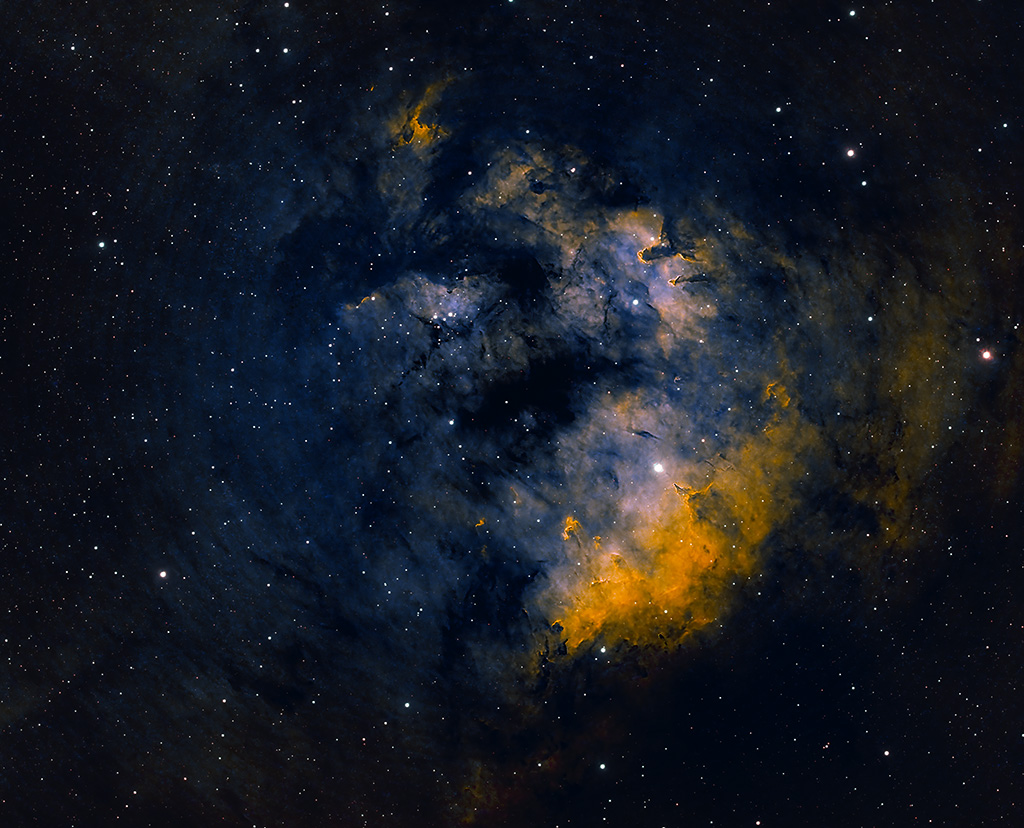
Sh2-205 is a large nebula on the border of the constellations Camelopardalis and Perseus at an estimated distance of approximately 3,200 light-years. Sh2-205 is commonly referred to as the Peanut Nebula. The nebula is classified as a HII region and is divided into 3 sections identified as SH 149.25-0.0, SH 148.83-0.67, and LBN 148.11-0.45. HII regions are typically the site of active star formation.
IMAGING DATA
Provo, Utah
Bortle 5 sky
Date: 11/9/2023
Image: SH 2-205
Size: 1.3 deg
Camera: ZWO ASI2600 MC Pro in Hyperstar Position
Filter: STC Astro Duo-Narrowband
Temperature: 0 deg C
Gain: 100
Binning: 1×1
Exposure: 180 seconds
# of Lights: 146 for 7 hours 18 minutes were used.
Telescope: Celestron 1100 Edge HD
Hyperstar IV Camera mount
Mount: 10Micron GM1000HPS
Pier: Steel pier on 600 lb concrete block
Observatory: NexDome “Y Mountain Observatory”
Software used
Deep Sky Stacker, Pixinsight, Photoshop
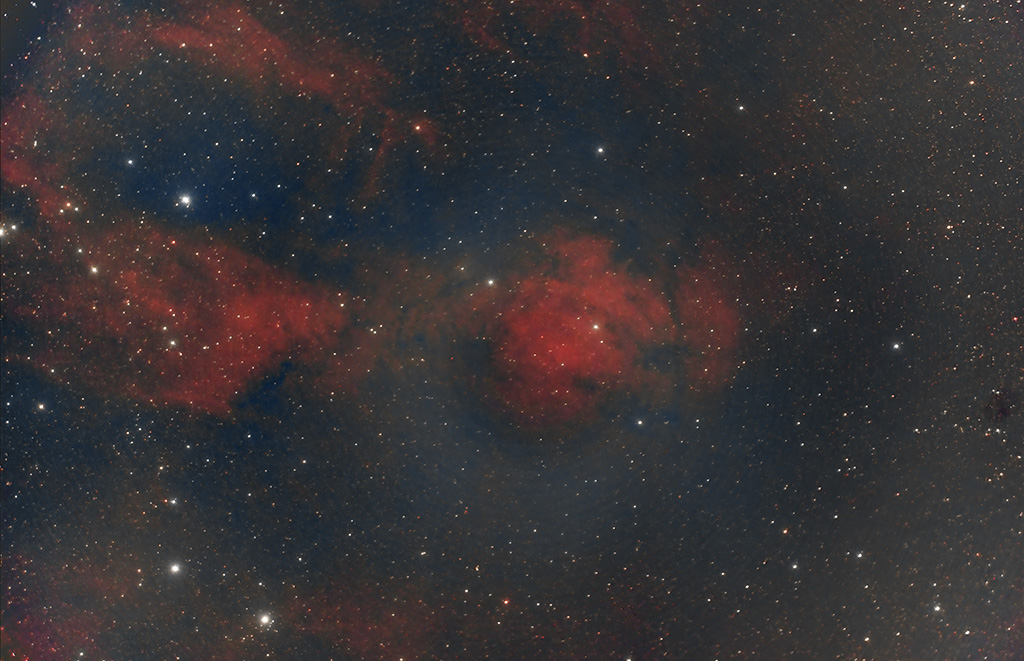
11/16/2023
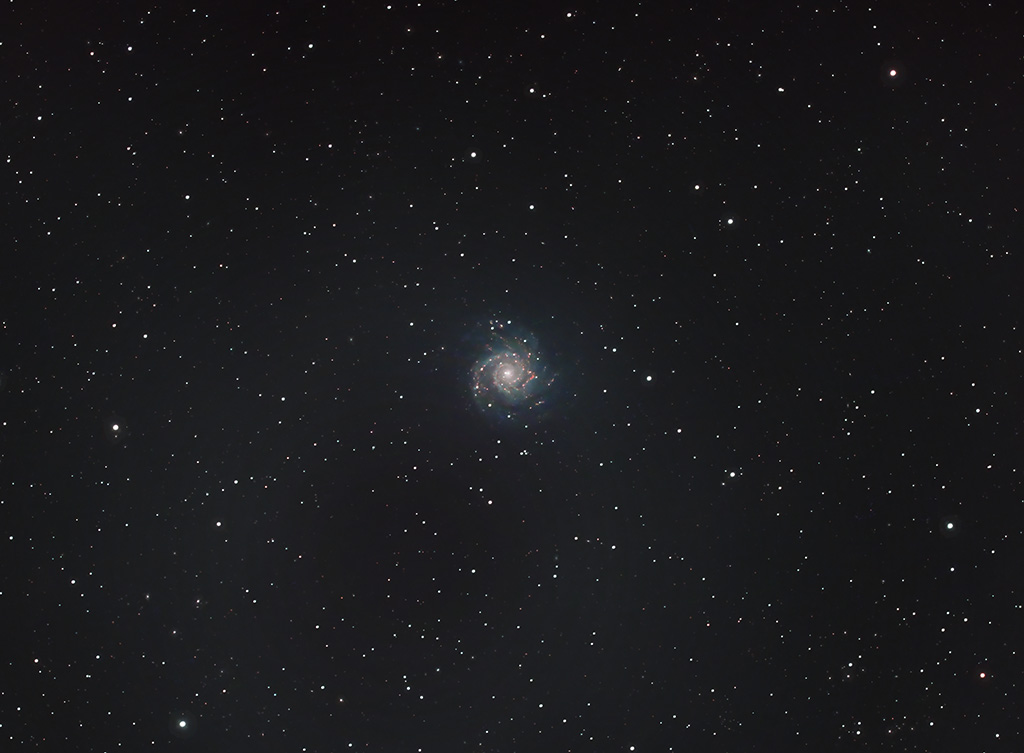
A stunning face-on spiral galaxy, M74 was discovered in 1780 by Charles Messier’s observing assistant, the French astronomer Pierre Méchain. M74 is located roughly 32 million light-years away from Earth in the constellation Pisces. With an apparent magnitude of only 10, the galaxy appears as a faint patch of light through small telescopes. It is best observed during November.
M74 is a perfect example of a grand-design spiral galaxy. Symmetrical spiral arms reach out from the galaxy’s central nucleus and are traced by winding dust lanes. The arms are dotted with clusters of young, blue stars and pink regions where the ultraviolet light from these young stars has ionized clouds of hydrogen and caused them to glow. NASA
IMAGING DATA
Provo, Utah
Bortle 5 sky
Date: 11/11&12/2023
Image: M 74
Size: 2 deg
Camera: ZWO ASI2600 MC Pro in Hyperstar Position
Filter: STC Astro Duo-Narrowband
Temperature: 0 deg C
Gain: 100
Binning: 1×1
Exposure: 180 seconds
# of Lights: 194 for 9 hours 42 minutes were used.
Telescope: Celestron 1100 Edge HD
Hyperstar IV Camera mount
Mount: 10Micron GM1000HPS
Pier: Steel pier on 600 lb concrete block
Observatory: NexDome “Y Mountain Observatory”
Software used